Showing posts with label Hugo Chavez. Show all posts

Tuesday, February 06, 2007

Rule By Decree


I quote him again:


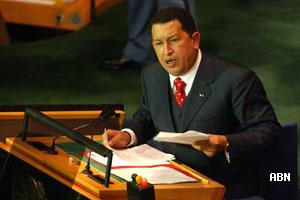
Does this man look 'unpopular'?"As anyone who studies the behavior of the U.S. empire during the last century discovers a common factor; every time the US are going to attack someone, they don’t do it right away, they start by preparing the terrain of their internal public opinion, one of the things that worries them the most....That way, when they launch the attack, they obtain the support of a big part of their internal public opinion. Almost all media in the country support them... they look for allies in Europe, from the U.N., they start preparing the terrain..."

Hugo Chavez, President of Venezuela
February 20, 2005


I was scanning news stories on the internet a couple of days ago when I ran across the following headline:


The report describes how the Venezuelan congress has ostensibly given it's President, Huge Chavez Frias, dictatorial powers to "rule by decree". Well, that certainly does sound like an alarming development when it's put that way. As if to ensure your alarm, the reporter begins as follows:

Convening in a downtown plaza in a session that resembled a political rally, lawmakers unanimously gave Chavez sweeping powers to legislate by decree and impose his radical vision of a more egalitarian socialist state.

"Long live the sovereign people! Long live President Hugo Chavez! Long live socialism!" said National Assembly President Cilia Flores as she proclaimed the "enabling law" approved by a show of hands. "Fatherland, socialism or death! We will prevail!"

The law gives Chavez, who is beginning a fresh six-year term, more power than he has ever had in eight years as president, and he plans to use it during the next 18 months to transform broad areas of public life, from the economy and the oil industry in particular, to "social matters" and the very structure of the state.

His critics call it a radical lurch toward authoritarianism by a leader with unchecked power — similar to how Fidel Castro monopolized leadership years ago in Cuba.

"If you have all the power, why do you need more power?" said Luis Gonzalez, a high school teacher who paused to watch in the plaza, calling it a "media show" intended to give legitimacy to a repugnant move. "We're headed toward a dictatorship, disguised as a democracy."

Oh, things certainly seem dire down there for each and every American trapped inside a Venezuelans body, screaming to get out, doesn't it? "It's the end of democracy", we're led to believe.

Of course, buried near the bottom of the story is this surprisingly reasonable statement from one State Department official in nearby Columbia:

"It's something valid under the constitution," said Shannon, the assistant secretary of state for Western Hemisphere affairs, told reporters in Colombia. "As with any tool of democracy, it depends how it is used," he added. "At the end of the day, it's not a question for the United States or for other countries, but for Venezuela."

What happened here? Did someone forget to fax the day's theme to this guy? What does he mean it's "valid under the constitution?" How are we supposed to paint Chavez as an anti-constitutional tyrant if we've got this guy down there citing facts about the Venezuelan constitution? Isn't he "emboldening the enemy"?

Let's delve further into this because I think we may be on to something. Eric Wingerter has penned what seems to be the definitive breakdown of what's behind this "enabling law" in Venezuela and the shrieking "rule by decree" headlines we're seeing in the US news media.

Mr. Wingerter, what say ye?

Did you hear that President Chavez is going to Rule by Decree for the next 18 months? The very idea evokes a picture of a not-too-distant South American past, one in which all-powerful executives live out their capricious whims and mete out brutal retribution against political enemies. It's all so dramatic and perverse and larger than life. Somewhere Andrew Lloyd Webber is already mapping out the musical score.

But in this case, it's just not true. Of course, if you've been reading the newspapers lately, you'd have a hard time figuring that out. The Miami Herald headline blares: "Chavez Granted Power to Rule by Decree." Time Magazine asks "Is Chavez Becoming Castro?" And those are the restrained ones. The right-wing rags have headlines like "A Dictatorship Rises," and "Hugo Chavez Kills Democracy." So you'd be forgiven for not getting the nuances in this storyline.

Here's what's actually happening: The Venezuelan assembly is poised to pass a law that will give the executive branch greater leeway to establish norms on a certain range of issues. Most of these involve guidelines for the president's own cabinet-level agencies. In other words, the Venezuelan version of the IRS will map out the country's tax structure; the Transportation department will devise its own strategic plan for public transit nationwide, etc. This represents a shift of certain powers from the legislative branch to the executive, to be sure, but on paper they don't seem to stray too far from the powers that the executive branch in the United States already has. Venezuelanaysis.com has a full listing of the ten issue areas that are affected.

It is important to note that this type of power-transfer is allowed under the Venezuelan constitution of 1999, which expressly permits the President to issue executive orders specifically within these issue areas. Of course, the constitution continues to guide the country's overall legal framework, which is to say that no "decree" can supercede constitutional law.

What's more, this "enabling law" is not new to the current constitution. Venezuela's previous constitution allowed for similar powers shifts to the executive, and you can be sure that past presidents took advantage of this authority on multiple occasions throughout the 70's, 80's and 90's.

OK, so it's not anything new and, contrary to rumor, Chavez hasn't been granted the power to "rule by decree" at all. Yet here we are being subjected to these screaming headlines described above in virtually every corner of the US media if not the world.

I find that particularly interesting because the nature of these new powers -- i.e. executive branch agencies being granted the right to write the rules governing their particular area of responsibility independent of legislative approval -- sounds eerily familiar.

Bush Directive Increases Sway on Regulation
[Registration req'd; Alternative link]
By ROBERT PEAR
Published: January 30, 2007 [New York Times]

WASHINGTON, Jan. 29 — President Bush has signed a directive that gives the White House much greater control over the rules and policy statements that the government develops to protect public health, safety, the environment, civil rights and privacy.

In an executive order published last week in the Federal Register, Mr. Bush said that each agency must have a regulatory policy office run by a political appointee, to supervise the development of rules and documents providing guidance to regulated industries. The White House will thus have a gatekeeper in each agency to analyze the costs and the benefits of new rules and to make sure the agencies carry out the president’s priorities.

This strengthens the hand of the White House in shaping rules that have, in the past, often been generated by civil servants and scientific experts. It suggests that the administration still has ways to exert its power after the takeover of Congress by the Democrats.

[Snip]

Consumer, labor and environmental groups denounced the executive order, saying it gave too much control to the White House and would hinder agencies’ efforts to protect the public.

Typically, agencies issue regulations under authority granted to them in laws enacted by Congress. In many cases, the statute does not say precisely what agencies should do, giving them considerable latitude in interpreting the law and developing regulations.

The directive issued by Mr. Bush says that, in deciding whether to issue regulations, federal agencies must identify “the specific market failure” or problem that justifies government intervention.

Besides placing political appointees in charge of rule making, Mr. Bush said agencies must give the White House an opportunity to review “any significant guidance documents” before they are issued.

[Snip]

Peter L. Strauss, a professor at Columbia Law School, said the executive order “achieves a major increase in White House control over domestic government.”

“Having lost control of Congress,” Mr. Strauss said, “the president is doing what he can to increase his control of the executive branch.”

So, in what way does this differ from what is being done in Venezuela, one might ask. Allow me to suggest some important distinctions:

1) In Venezuela the measure is temporary, with the powers set to expire after 18 months. Not so in the US where the change is permanent.

2) In Venezuela the measure was adopted after a vote of the duly-elected representatives in that nation's legislature. In the US it happened by Executive Order, quietly and without the consultation of any other branch of government -- a decree, if you will.

3) In Venezuela the measure applies to a President who does not subscribe to a Unitary Executive Theory, unlike the President of the United States.


One can only wonder why a temporary legislative measure in the distant land of Venezuela sets off more alarm bells and feigned concern for the state of democracy than does the odious Unitary Executive Theory, the avowed philosophy of its own President, in the American news media.

Is that sulfur I smell?


More:

Bush Seizes Power While Media Fixates on Chavez
Eric Wingeter on Chavez' "Rule by Decree"

Read more...

Sunday, September 24, 2006

Hugo Chavez' Address to the 61st UN General Assembly

Venezuelan President Hugo Chavez Frias is one of those people in the world who will seldom be allowed to speak for himself in the US media. For the past few days I have read and watched with dismay the narrowly focused overage of his speech to the 61st UN General Assembly on September 20, 2006. In an effort counteract this and, in my own small way, to elevate the discourse on the subject I am posting the full translated text and the video in both languages here. It's long but, in view of the recent reporting and commentary about it, I think it's well worth the trip. I've also taken the liberty to add hyperlinked annotations to the text to enhance the experience for the reader.

Address to the 61st UN General Assembly of the United Nations
Hugo Chavez Frias, President of Venezuela
New York, NY
September 20, 2006


See video
English / Spanish
(Real Player Req'd)


Representatives of the governments of the world, good morning to all of you. First of all, I would like to invite you, very respectfully, to those who have not read this book, to read it. Noam Chomsky, one of the most prestigious American and world intellectuals, Noam Chomsky, and this is one of his most recent books, "Hegemony or Survival: The Imperialist Strategy of the United States.' [Holds up book, waves it in front of General Assembly.] "It's an excellent book to help us understand what has been happening in the world throughout the 20th century, and what's happening now, and the greatest threat looming over our planet.

The hegemonic pretensions of the American empire are placing at risk the very survival of the human species. We continue to warn you about this danger and we appeal to the people of the United States and the world to halt this threat, which is like a sword hanging over our heads. I had considered reading from this book, but, for the sake of time," [flips through the pages, which are numerous] "I will just leave it as a recommendation.

It reads easily, it is a very good book, I'm sure Madame [President] you are familiar with it. It appears in English, in Russian, in Arabic, in German. I think that the first people who should read this book are our brothers and sisters in the United States, because their threat is right in their own house.

The devil is right at home. The devil, the devil himself, is right in the house.

"And the devil came here yesterday. Yesterday the devil came here. Right here." [crosses himself] "And it smells of sulfur still today.

Yesterday, ladies and gentlemen, from this rostrum, the president of the United States, the gentleman to whom I refer as the devil, came here, talking as if he owned the world. Truly. As the owner of the world.

I think we could call a psychiatrist to analyze yesterday's statement made by the president of the United States. As the spokesman of imperialism, he came to share his nostrums, to try to preserve the current pattern of domination, exploitation and pillage of the peoples of the world.

An Alfred Hitchcock movie could use it as a scenario. I would even propose a title: "The Devil's Recipe."

As Chomsky says here, clearly and in depth, the American empire is doing all it can to consolidate its system of domination. And we cannot allow them to do that. We cannot allow world dictatorship to be consolidated.

The world parent's statement -- cynical, hypocritical, full of this imperial hypocrisy from the need they have to control everything.

They say they want to impose a democratic model. But that's their democratic model. It's the false democracy of elites, and, I would say, a very original democracy that's imposed by weapons and bombs and firing weapons.

What a strange democracy. Aristotle might not recognize it or others who are at the root of democracy.

What type of democracy do you impose with marines and bombs? The president of the United States, yesterday, said to us, right here, in this room, and I'm quoting, "Anywhere you look, you hear extremists telling you can escape from poverty and recover your dignity through violence, terror and martyrdom."

Wherever he looks, he sees extremists. And you, my brother -- he looks at your color, and he says, oh, there's an extremist. Evo Morales, the worthy president of Bolivia, looks like an extremist to him.

The imperialists see extremists everywhere. It's not that we are extremists. It's that the world is waking up. It's waking up all over. And people are standing up.

I have the feeling, dear world dictator, that you are going to live the rest of your days as a nightmare because the rest of us are standing up, all those who are rising up against American imperialism, who are shouting for equality, for respect, for the sovereignty of nations.

Yes, you can call us extremists, but we are rising up against the empire, against the model of domination.

The president then -- and this he said himself, he said: "I have come to speak directly to the populations in the Middle East, to tell them that my country wants peace."

That's true. If we walk in the streets of the Bronx, if we walk around New York, Washington, San Diego, in any city, San Antonio, San Francisco, and we ask individuals, the citizens of the United States, what does this country want? Does it want peace? They'll say yes.

But the government doesn't want peace. The government of the United States doesn't want peace. It wants to exploit its system of exploitation, of pillage, of hegemony through war.

It wants peace. But what's happening in Iraq? What happened in Lebanon? In Palestine? What's happening? What's happened over the last 100 years in Latin America and in the world? And now threatening Venezuela -- new threats against Venezuela, against Iran?

He spoke to the people of Lebanon. Many of you, he said, have seen how your home and communities were caught in the crossfire. How cynical can you get? What a capacity to lie shamefacedly. The bombs in Beirut with millimetric precision? This is crossfire? He's thinking of a western, when people would shoot from the hip and somebody would be caught in the crossfire.

This is imperialist, fascist, assassin, genocidal, the empire and Israel firing on the people of Palestine and Lebanon. That is what happened. And now we hear, "We're suffering because we see homes destroyed.'

The president of the United States came to talk to the peoples -- to the peoples of the world. He came to say -- I brought some documents with me, because this morning I was reading some statements, and I see that he talked to the people of Afghanistan, the people of Lebanon, the people of Iran. And he addressed all these peoples directly.

And you can wonder, just as the president of the United States addresses those peoples of the world, what would those peoples of the world tell him if they were given the floor? What would they have to say?

And I think I have some inkling of what the peoples of the south, the oppressed people think. They would say, "Yankee imperialist, go home." I think that is what those people would say if they were given the microphone and if they could speak with one voice to the American imperialists.

And that is why, Madam President, my colleagues, my friends, last year we came here to this same hall as we have been doing for the past eight years, and we said something that has now been confirmed -- fully, fully confirmed.

I don't think anybody in this room could defend the system. Let's accept -- let's be honest. The U.N. system, born after the Second World War, collapsed. It's worthless.

Oh, yes, it's good to bring us together once a year, see each other, make statements and prepare all kinds of long documents, and listen to good speeches, like Abel's yesterday [Thabo Mbeki of South Africa]* (Report / Text /Video), or President Mullah's [Mahmoud Ahmadinejad of Iran] (Report /Text / Video). Yes, it's good for that. And there are a lot of speeches, and we've heard lots from the president of Sri Lanka (Report/ Text /Video), for instance, and the president of Chile (Report /Text / Video).

But we, the assembly, have been turned into a merely deliberative organ. We have no power, no power to make any impact on the terrible situation in the world. And that is why Venezuela once again proposes, here, today, 20 September, that we re-establish the United Nations.

Last year, Madam, we made four modest proposals that we felt to be crucially important. We have to assume the responsibility our heads of state, our ambassadors, our representatives, and we have to discuss it.

The first is expansion, and Mullah talked about this yesterday right here. The Security Council, both as it has permanent and non-permanent categories, (inaudible) developing countries and LDCs must be given access as new permanent members. That's step one.

Second, effective methods to address and resolve world conflicts, transparent decisions.

Point three, the immediate suppression -- and that is something everyone's calling for -- of the anti-democratic mechanism known as the veto, the veto on decisions of the Security Council.

Let me give you a recent example. The immoral veto of the United States allowed the Israelis, with impunity, to destroy Lebanon. Right in front of all of us as we stood there watching, a resolution in the council was prevented.

Fourthly, we have to strengthen, as we've always said, the role and the powers of the secretary general of the United Nations.

Yesterday, the secretary general practically gave us his speech of farewell. And he recognized that over the last 10 years, things have just gotten more complicated; hunger, poverty, violence, human rights violations have just worsened. That is the tremendous consequence of the collapse of the United Nations system and American hegemonistic pretensions.

Madam, Venezuela a few years ago decided to wage this battle within the United Nations by recognizing the United Nations, as members of it that we are, and lending it our voice, our thinking.

Our voice is an independent voice to represent the dignity and the search for peace and the reformulation of the international system; to denounce persecution and aggression of hegemonistic forces on the planet.

This is how Venezuela has presented itself. Bolivar's home has sought a nonpermanent seat on the Security Council.

Let's see. Well, there's been an open attack by the U.S. government, an immoral attack, to try and prevent Venezuela from being freely elected to a post in the Security Council.

The imperium is afraid of truth, is afraid of independent voices. It calls us extremists, but they are the extremists. And I would like to thank all the countries that have kindly announced their support for Venezuela, even though the ballot is a secret one and there's no need to announce things.

But since the imperium has attacked, openly, they strengthened the convictions of many countries. And their support strengthens us.

Mercosur, as a bloc, has expressed its support, our brothers in Mercosur. Venezuela, with Brazil, Argentina, Paraguay, Uruguay, is a full member of Mercosur.

And many other Latin American countries, CARICOM, Bolivia have expressed their support for Venezuela. The Arab League, the full Arab League has voiced its support. And I am immensely grateful to the Arab world, to our Arab brothers, our Caribbean brothers, the African Union. Almost all of Africa has expressed its support for Venezuela and countries such as Russia or China and many others.

I thank you all warmly on behalf of Venezuela, on behalf of our people, and on behalf of the truth, because Venezuela, with a seat on the Security Council, will be expressing not only Venezuela's thoughts, but it will also be the voice of all the peoples of the world, and we will defend dignity and truth.

Over and above all of this, Madam President, I think there are reasons to be optimistic. A poet would have said "helplessly optimistic," because over and above the wars and the bombs and the aggressive and the preventive war and the destruction of entire peoples, one can see that a new era is dawning.

As Silvio Rodriguez says, the era is giving birth to a heart. There are alternative ways of thinking. There are young people who think differently. And this has already been seen within the space of a mere decade. It was shown that the end of history was a totally false assumption, and the same was shown about Pax Americana and the establishment of the capitalist neo-liberal world. It has
been shown, this system, to generate more poverty. Who believes in it now?

What we now have to do is define the future of the world. Dawn is breaking out all over. You can see it in Africa and Europe and Latin America and Oceanea.

I want to emphasize that optimistic vision. We have to strengthen ourselves, our will to do battle, our awareness. We have to build a new and better world.

Venezuela joins that struggle, and that's why we are threatened. The U.S. has already planned, financed and set in motion a coup in Venezuela, and it continues to support coup attempts in Venezuela and elsewhere.

President Michelle Bachelet reminded us just a moment ago of the horrendous assassination of the former foreign minister, Orlando Letelier.

And I would just add one thing: Those who perpetrated this crime are free. And that other event where an American citizen also died were American themselves. They were CIA killers, terrorists.

And we must recall in this room that in just a few days there will be another anniversary. Thirty years will have passed from this other horrendous terrorist attack on the Cuban plane, where 73 innocents died, a Cubana de Aviacion airliner.

And where is the biggest terrorist of this continent who took the responsibility for blowing up the plane? He spent a few years in jail in Venezuela. Thanks to CIA and then government officials, he was allowed to escape, and he lives here in this country, protected by the government.

And he was convicted. He has confessed to his crime. But the U.S. government has double standards. It protects terrorism when it wants to.

And this is to say that Venezuela is fully committed to combating terrorism and violence. And we are one of the people who are fighting for peace.

Luis Posada Carriles is the name of that terrorist who is protected here. And other tremendously corrupt people who escaped from Venezuela are also living here under protection: a group that bombed various embassies, that assassinated people during the coup. They kidnapped me and they were going to kill me, but I think God reached down and our people came out into the streets and the army was too, and so I'm here today.

But these people who led that coup are here today in this country protected by the American government. And I accuse the American government of protecting terrorists and of having a completely cynical discourse.

We mentioned Cuba. Yes, we were just there a few days ago. We just came from there happily.

And there you see another era born. The Summit of the 15, the Summit of the Nonaligned, adopted a historic resolution. This is the outcome document. Don't
worry, I'm not going to read it.

But you have a whole set of resolutions here that were adopted after open debate in a transparent matter -- more than 50 heads of state. Havana was the capital of the south for a few weeks, and we have now launched, once again, the group of the nonaligned with new momentum.

And if there is anything I could ask all of you here, my companions, my brothers and sisters, it is to please lend your good will to lend momentum to the Nonaligned Movement for the birth of the new era, to prevent hegemony and prevent further advances of imperialism.

And as you know, Fidel Castro is the president of the nonaligned for the next three years, and we can trust him to lead the charge very efficiently.

Unfortunately they thought, "Oh, Fidel was going to die." But they're going to be disappointed because he didn't. And he's not only alive, he's back in his green fatigues, and he's now presiding the nonaligned.

So, my dear colleagues, Madam President, a new, strong movement has been born, a movement of the south. We are men and women of the south.

With this document, with these ideas, with these criticisms, I'm now closing my file. I'm taking the book with me. And, don't forget, I'm recommending it very warmly and very humbly to all of you.

We want ideas to save our planet, to save the planet from the imperialist threat. And hopefully in this very century, in not too long a time, we will see this, we will see this new era, and for our children and our grandchildren a world of peace based on the fundamental principles of the United Nations, but a renewed United Nations. And maybe we have to change location. Maybe we have to put the United Nations somewhere else; maybe a city of the south. We've proposed Venezuela.

You know that my personal doctor had to stay in the plane. The chief of security had to be left in a locked plane. Neither of these gentlemen was allowed to arrive and attend the U.N. meeting. This is another abuse and another abuse of power on the part of the Devil. It smells of sulfur here, but God is with us and I embrace you all.

May God bless us all. Good day to you.


Addendum: As he was leaving the country the visiting Venezuelan Foreign Minister, Nicolas Maduro, was also detained by US authorities and strip searched on the basis of "terrorism" accusations related to the failed Venezuelan coup of 1992. But they say Chavez' speech is the example of bad diplomacy. Go figure.

Update 9/27/2006: It has come to my attention that I posted the video to Chavez' address from last year's General Assembly in error. I have corrected the error, edited my links and made the appropriate changes in the first paragraph.


* - "Abel" is presumed to be a reference to South African President Thabo Mbeki's speech the previous day in which he made reference to the biblical story of Cain and Abel.

Read more...