Next, After the Speech
Via Norm at OneGoodMove.Org, the programming lineup following the President's speech:
There's poetry all around you, if you just look for it.

Via Norm at OneGoodMove.Org, the programming lineup following the President's speech:
There's poetry all around you, if you just look for it.
A buddy of mine joked recently that these BushCo people are making me look like a genius. I got a good laugh out of that one but I'm here to tell you that it just ain't so. It's not them and I'm not a genius or an insider. The truth is that I simply have a fool-proof method for dead-on-balls accurate political punditocritizin' and, for a limited time, I'm willing to share my secrets with the general public.
My simple step-by-step method is guaranteed to make anyone, from any walk of life, a reliable and credible political pundit virtually instantly. Just follow these quick and easy steps:
Step #1: Listen to or read a statement from President Bush, anyone in his administration or any of their supporters in congress or the media, making careful note of their arguments and assertions.
Step #2: Assume the exact opposite to be true.
Step #3: Tell all your friends that exact opposite formulation as if it were a confirmed fact while -- and this important -- actually having no factual idea yourself. Write scalding letters to the editor sticking your neck out on these assertions. Post it in your blog if you have one. If you don't have one, start one and post it there. Accost strangers on the elevator with it. Go nuts.
Step #4: NOW (and only now) go do some research.
Step #5: Find out you were right. Laugh about it. Show your spouse or significant other.
Following up on my previous post, I've run across two articles online that further examine the nature of the US occupation of Iraq and the coming escalation. The first comes from Michael Klare in the The Nation. Are you wondering why would the US would put a naval man in charge of the land-based CENTCOM forces in the middle-east? Klare explains:Part of the explanation for this move, of course, is a desire by the White House to sweep away bitter ground-force commanders like Abizaid and Casey who had opposed an increase in US troops in Iraq and argued for shifting greater responsibility for the fighting to Iraq forces, thereby permitting a gradual American withdrawal. "The Baghdad situation requires more Iraqi troops," not more Americans, Abizaid said in a recent interview with the New York Times. For this alone, Abizaid had to go. But there's more to it. Abizaid, who is of Lebanese descent and served a tour of duty with UN forces in Lebanon, has come to see the need for a regional solution to the crisis in Iraq--one that inevitably requires some sort of engagement with Iran and Syria, as recommended by the Iraq Study Group
[Snip]
If engagement with Iran and Syria was even remotely on the agenda, Abizaid is exactly the man you'd want on the job at Centcom overseeing US forces and strategy in the region. But if that's not on the agenda, if you're thinking instead of using force against Iran and/or Syria, then Admiral Fallon is exactly the man you'd want at Centcom.
Why? Because combined air and naval operations are his forté. Fallon began his combat career as a Navy combat flyer in Vietnam, and he served with carrier-based forces for twenty-four years after that. He commanded a carrier battle wing during the first Gulf War in 1991 and led the naval group supporting NATO operations during the Bosnia conflict four years later. More recently, Fallon served as vice chief of naval operations before becoming the head of Pacom in 2005. All this means that he is primed to oversee an air, missile and naval attack on Iran, should the President give the green light for such an assault--and the fact that Fallon has been moved from Pacom to Centcom means that such a move is very much on Bush's mind.
The second is from Frank Rich of the New York Times. Using the recent media coverage of the Gerald Ford funeral as a springboard, Rich compares and contrasts Ford's presidential style with that of the current president, which is a very interesting read all by itself. But then... It's against the backdrop of both the Hussein video and the Ford presidency that we must examine the prospect of that much-previewed "surge" in Iraq - a surge, by the way, that the press should start calling by its rightful name, escalation. As Mr. Ford had it, America cannot regain its pride by refighting a war that is finished as far as America is concerned and, for that matter, as far as Iraq is concerned. By large margins, the citizens of both countries want us not to escalate but to start disengaging. So do America's top military commanders, who are now being cast aside just as Gen. Eric Shinseki was when he dared assert before the invasion that securing Iraq would require several hundred thousand troops.
It would still take that many troops, not the 20,000 we might scrape together now. Last month the Army and Marines issued an updated field manual on counterinsurgency (PDF) supervised by none other than Lt. Gen. David Petraeus, the next top American military commander in Iraq. It endorsed the formula that "20 counterinsurgents per 1,000 residents" is "the minimum troop density required." By that yardstick, it would take the addition of 100,000-plus troops to secure Baghdad alone.
The "surge," then, is a sham. It is not meant to achieve that undefined "victory" Mr. Bush keeps talking about but to serve his own political spin. His real mission is to float the "we're not winning, we're not losing" status quo until Jan. 20, 2009. After that, as Joseph Biden put it last week, a new president will "be the guy landing helicopters inside the Green Zone, taking people off the roof." This is nothing but a replay of the cynical Nixon-Kissinger "decent interval" exit strategy concocted to pass the political buck (to Mr. Ford, as it happened) on Vietnam.
As the White House tries to sell this flimflam, picture fresh American troops being tossed into Baghdad's caldron to work alongside the Maliki-Sadr Shiite lynch mob that presided over the Saddam hanging. Contemplate as well Gerald Ford's most famous words, spoken as he assumed the presidency after the Nixon resignation: "Our Constitution works; our great republic is a government of laws and not of men. Here the people rule."
This time the people do not rule. Two months after Americans spoke decisively on Election Day, the president is determined to overrule them. Our long national nightmare in Iraq, far from being over, is about to get a second wind.
Indeed.
The Sunday Times of London is reporting that Israel is planning a nuclear strike against Iran's nuclear enrichment facilities. The strike is described as involving conventional nukes to open a tunnel underground after which "tactical" nuclear weapons (that's "weapons", with an 's') are to be used to destroy the facilities.
Israel has already issued a denial of the report.
These "tactical" nukes are said to have about 1/15th of destructive force of the atomic bombs used on Hiroshima and Nagasaki and the desired underground detonation is designed to limit the risk of nuclear fallout. There now, that's comforting, isn't it?
An aside: If you do a Google or Yahoo news search on this story using the terms "Israel plans nuclear Iran", for example, you'll find that the overwhelming majority (if not all) of the stories covering the original report on these plans come from media sources outside of the US. But the US media is well represented in the list of stories detailing Israel's denial of the report. I though that was interesting.
Over a year ago Vice President Dick Cheney foreshadowed the end-game:The point still stands. Read more..."Well, one of the concerns people have is that Israel might do it without being asked, that if, in fact, the Israelis became convinced the Iranians had significant nuclear capability, given the fact that Iran has a stated policy that their objective is the destruction of Israel, the Israelis might well decide to act first, and let the rest of the world worry about cleaning up the diplomatic mess afterwards."
That sounds so much like a tacit recommendation cloaked in plausible deniability that I just can't stand it. But one could argue that he didn't mean it that way at all. After all, that's what plausible deniability is all about.
But Thursday, President Bush gave us the confirmation and removed all doubt. In the same press statement cited here earlier, where he described this as "American policy", he also said:And now's the time to address the root cause of the problem, and the root cause of the problem is terrorist groups trying to stop the advance of democracies. Hezbollah attacked Israel. I believe Hezbollah -- I know Hezbollah is connected to Iran. And now's the time for the world to confront this danger."
That's where this is going. That's what this is all for. All the rest is pretext. Israel is initiating a plan drawn up by us to facilitate a military strike, possibly a nuclear one, on Iran. This is the latest great event that we will be asked to believe will revolutionize the middle-east for the better. It is an apocalyptic vision bathed in blood. What's worse, it will fail and it will backfire on all of us. God help us all.
Every now and then I find myself in "enemy" territory.
For instance, I was invited to a small New Year's Eve gathering by some relatively new acquaintances. I understand that many of my views are hard for some folks to swallow at first glance. They cut against the "mainstream", nightly news grain so I don't walk into new environments with pistols blazing or anything. But sometime during the football game the subject of Iraq came up because of Saddam's execution -- it wasn't me, I promise. The reaction of the people there was one of celebration on the one hand and disgust that Muslims could possibly have any complaints about it on the other. So, right then and there it was clear. This is not my target audience -- but maybe they should be.
Anyway, I have nothing against these folks. They seemed damned decent to me and I liked them. They didn't strike me as partisan political junkies at all. They were ordinary folks who, like anyone else, were reacting to the news of the day. But the conversation was peppered with vintage BushCo talking points despite the fact that I didn't get the feeling these were rabid Bush supporters. Still, they were riding the "fight them there so we don't have to fight them here" horse like Willie Shoemaker. That stuff is like horseradish or dirty diapers to me -- damned near impossible to ignore. It's hard to let that stuff go unanswered.
My opening came when one of the guests mentioned that our involvement in the war was now longer than our involvement in World War II. That factoid seemed to surprise some of the others in the room and that gave me the opportunity send up my trial balloon.
"That's true," I said, "but when you really think about it, it's not really a war so much as it is an occupation," I offered helpfully.
"I mean, there's not really a line of troops with tanks, air support, attack chopper and gunships facing our guys over there," I added.
I finished it off with what I admit was a bit of superficial rhetorical camouflage, "So, if you look at it in terms of other occupations, it's not really that long at all."
Everyone reacted positively to that one, to my pleasant surprise, agreeing that it was more like an occupation than a hot war like WWII or even Vietnam.
Seed Planted
The distinction between war and occupation is an important one when it comes to people's perception of our involvement in Iraq. The Bush administration seems to realize that as long as they can keep the public locked into the war paradigm they can still kick up little dust-bunnies of support for their program. Their well-worn assortment of schoolyard taunts, accusing critics of wanting to "cut & run" or "appease the enemy" are just enough to earn them at least the grudging support of an American public that feels obligated to back their country in a war, right or wrong.
But something happened in that room when I managed to get people to acknowledge the true nature of what's happening in Iraq. Once they accepted the idea of it being an occupation instead of a war all the talk of "victory" ended abruptly. Now, one might suspect that this happened because I'd made them uncomfortable, but I don't think so. That's not the feeling I got. What I think really happened is that everyone realized that you can't win an occupation the way you can win a war.
So here we see how language, the words we choose to use, effects the direction and tone of the debate -- a fact that I promise you is not lost on the Bush Administration. The power of language is why our media establishment is so squeamish about naming the obvious civil war that is taking place in Iraq. They insist on calling it all "sectarian violence" because "civil war" just seems too damning for their tastes and those of the White House. They would be even more squeamish about labeling our presense there an occupation if any significant pressure to do so even existed.
If it's called a war then the more than 3,000 dead servicemen can be minimized as insignificant compared to other wars. But that's not a fair comparison, is it? How do those numbers stack up in comparison to other occupations? How many of our troops died in Germany? Japan? The Balkans? Somalia? Need a I go on? That simple shift of the paradigm changes the whole ballgame.
War allows people to behave like cheerleaders, cheering on our armed services as they slug it out against military adversaries who can be tangibly defeated. Victory is easily defined as the operational incapacitation of the enemy. Whoo-hah.
Occupation, on the other hand, is a completely different animal. An occupation is carried out against a civilian population and it's a lot harder to get decent, ordinary Americans cheering for military assaults on civilians.
What's more, the only possible victory that exists in the occupation of people who neither want to be occupied nor share your goals for their country is the continuance of the occupation. Victory is no longer an attractive end to be achieved but a seemingly permanent, artificial condition to maintained. As such, an occupation mind-set forces people back home, like the ones I met last night, to think and ask the only questions that matter.
"Why are we there again?" and "When are we going to leave?"
Why are we there?
Because being there is the whole point. Being there to control the oil supply; being there to threaten Iran and Syria; and being there to influence the region by our very presence are all the stated reasons outlined by top Bush Administration officials years before 9/11 ever happened.
We don't have to speculate on any this because these fools wrote it all down long ago in a series of documents dating back as early as 1992. The message was tweaked, expounded upon and polished again until it was finally published on the web at the website of the Project for the New American Century (PNAC). A full year before the events of 9/11 ever happened, in a document entitled "Rebuilding America's Defenses" (PDF file) the PNAC spelled it all out very plainly:
Indeed, the United States has for decades sought to play a more permanent role in Gulf regional security. While the unresolved conflict with Iraq provides the immediate justification, the need for a substantial American force presence in the Gulf transcends the issue of the regime of Saddam Hussein.
An aside: For those of you doing Vietnam analogies at home:Troop surge & expansion = escalation
Iran and/or Syria = Cambodia
• fight and decisively win multiple, simultaneous major theater wars;
• perform the “constabulary” duties associated with shaping the security critical regions;
RESTORE THE PERSONNEL STRENGTH of today’s force to roughly the levels anticipated in the “Base Force” outlined by the Bush Administration, an increase in active-duty strength from 1.4 million to 1.6 million. [read: "Expand the military"]
REPOSITION U.S. FORCES to respond to 21st century strategic realities by shifting permanently-based forces to Southeast Europe and Southeast Asia, and by changing naval deployment patterns to reflect growing U.S. strategic concerns in East Asia.
After eight years of no-fly-zone operations, there is little reason to anticipate that the U.S. air presence in the region should diminish significantly as long as Saddam Hussein remains in power... From an American perspective, the value of such bases would endure even should Saddam pass from the scene. Over the long term, Iran may well prove as large a threat to U.S. interests in the Gulf as Iraq has. And even should U.S.-Iranian relations improve, retaining forward-based forces in the region would still be an essential element in U.S. security strategy given the longstanding American interests in the region.
At the heart of George W. Bush’s “new way forward” – which the president is expected to announce on Wednesday and involve substantial troop reinforcements – is the plan already under way to expand the US civilian presence across Iraq and complete the world’s largest embassy in Baghdad.
Construction of what critics call “Fortress Baghdad” has led to arguments inside the State Department amid fears that the overwhelming diplomatic presence will perpetuate a sense of US occupation and become a focus of local anger.
[Snip]
The embassy compound being built inside Baghdad’s Green Zone covers 104 acres, making it six times larger than the United Nations compound in New York. A city within a city for more than 1,000 people, it will have its own water, sewers and electricity, six apartment buildings, a Marine barracks, swimming pool, shops and some walls 15 feet thick.
The State Department has told the Financial Times that the US civilian presence in Iraq has “grown considerably beyond the numbers projected for the new embassy compound”, which is scheduled for completion by September 1 at a cost of $592m (€455m, £307m).
[Snip]
Condoleezza Rice, secretary of state, and other officials have repeatedly sent cables to personnel around the world saying diplomats have a patriotic duty to volunteer for Baghdad and the expanding “provincial reconstruction teams”, where diplomats work out of military bases.
“Baghdad dwarfs everything else. It is becoming a monster that has to be fed every year with a new crop of volunteers,” says one diplomat.
[Snip]
John Brown, who resigned as a US diplomat in protest against the 2003 invasion and now teaches public diplomacy, says the embassy “will be a symbol of the US occupation and the near-total separation of US embassy staff members from the society with which they are supposed to interact”.
“Indeed, the planned embassy reminds me of the huge, cavernous buildings that housed Soviet missions in eastern Europe during the cold war. They were hated by the local population for all they stood for: secrecy, arrogance and domination.”
[Federally-mandated "I don't like Saddam either" disclaimer*]
Not that Saddam Hussein deserves any sympathy but...

A Dictator Created Then Destroyed By America
"Our masters will tell us in a few hours that it is a "great day" for Iraqis and will hope that the Muslim world will forget that his death sentence was signed - by the Iraqi "government", but on behalf of the Americans - on the very eve of the Eid al-Adha, the Feast of the Sacrifice, the moment of greatest forgiveness in the Arab world."
"But history will record that the Arabs and other Muslims and, indeed, many millions in the West, will ask another question this weekend, a question that will not be posed in other Western newspapers because it is not the narrative laid down for us by our presidents and prime ministers - what about the other guilty men?"
He Takes His Secrets to the Grave. Our Complicity Dies With Him
How the west armed Saddam, fed him intelligence on his 'enemies', equipped him for his atrocities - and then made sure he wouldn't squeal.
How Washington and London Helped Create the Monster They Went to War to Destroy
"When they hanged him, he was America's vanquished foe, likened to Hitler and Stalin for the murderous evil of his ways. What is forgotten is that once, for more than a decade, Saddam Hussein was staunchly supported by the US."
NOTE: I really am composing my follow-up to the Dixie topic, believe me. I just suffer a bit from blogger ADD and all this interesting stuff keeps coming up, like this one.
Former President Jimmy Carter has penned a new book critical of Israel and US policy in Palestine entitled, "Palestine: Peace, Not Apartheid" . With regard to that title I humbly give reference to an earlier post from these very pages on the subject. This is a book I definitely plan to pick up.
Democracy Now! has a post up about the minor controversy surrounding this book. The entry is notable not only for Mr. Carter's viewpoint -- one that is rarely if ever heard in our ostensibly free press -- but also for it's citation of the sharp criticism of those views coming not only from the political right and the usual assortment of Israelophiles collectively known as the "Pro-Israel lobby" but also from the supposed political left in the form of such persons as incoming House Speaker, Nancy Pelosi, and the incoming Judiciary Chairman John Conyers. Check this out...
Former U.S. President Jimmy Carter is accusing Israel of creating an apartheid system in the West Bank and Gaza. The charge comes in his new book "Palestine: Peace Not Apartheid."
The Nobel Peace Prize winner has been deeply involved in Middle East policies for the past three decades. As president he negotiated the Camp David Accords - which secured a lasting peace between Israel and Egypt.
In his new book, Jimmy Carter writes, "Israel's continued control and colonization of Palestinian land have been the primary obstacles to a comprehensive peace agreement in the Holy Land."
Carter criticizes Israel for building what he describes as an imprisonment wall through the West Bank. He accuses Israel of strangling the residents of Gaza where the poverty rate has reached 70 percent and where the malnutrition rate mirrors countries in Sub-Saharan Africa. And Carter is critical of Washington's role. He writes, "The United States is squandering international prestige and goodwill and intensifying global anti-American terrorism by unofficially condoning or abetting the Israeli confiscation and colonization of Palestinian territories."
Imagine, if you will, a modern apartheid state with first, second and eleventh class citizens, all required to carry identification specifying their ethnic origin. First class citizens are obliged to serve in the armed forces, kept on ready reserve status until in their forties, and accorded an impressive array of housing, medical, social security, educational and related benefits denied all others.And let us not forget the views of Oren Ben Dor, an Israeli citizen who teaches Philosophy at Southampton University's School of Law in the UK. On the recent Isreali demolition of the entire nation of Lebanon he writes...
Second class citizens are exempted from military service and from a number of the benefits accorded citizens of the first class. They are issued identity documents and license plates that allow them to be profiled by police at a distance. Second class citizens may not own land in much of the country and marriages between them and first class citizens are not recognized by the state. Second class citizens are sometimes arrested without trial and police torture, while frowned upon and occasionally apologized for, commonly occurs.
Citizens of the eleventh class, really not citizens at all, have no rights citizens of the first class or their government are bound to respect. Their residence is forbidden in nearly nine-tenths of the country, all of which they used to own. The areas left to them are cut up into smaller and smaller portions weekly, by high walls, free fire zones and hundreds of checkpoints manned by the army of the first class citizens, so that none can travel a dozen miles in any direction to work, school, shopping, a job, a farm, a business or a hospital without several long waits, humiliating searches and often arbitrary denials of the right to pass or to return. Posh residential settlements for the first class citizens with protecting gun towers and military bases are built with government funds and foreign aid on what used to be the villages and farms and pastures of the eleventh class citizens. The settlers are allotted generous additional housing and other subsidies, allowed to carry weapons and use deadly force with impunity against the former inhabitants, and are connected with the rest of first class territory by a network of of first-class citizen only roads.
Citizens of the eleventh class are routinely arrested, tortured, and held indefinitely without trial. Political activism among them is equated to “terrorism” and the state discourages such activity by means including but not limited to the kidnapping of suspects and relatives of suspects, demolition of their family homes, and extralegal assassination, sometimes at the hands of a death squad, or at others times by lobbing missiles or five hundred pound bombs into sleeping apartment blocks or noonday traffic. Passports are not issued to these citizens, and those who take advantage of scarce opportunities to study or work abroad are denied re-entry.
The apartheid state in question is, of course, Israel. Its first class citizens are Israeli Jews, the majority of them of European or sometimes American origin. The second class citizens are Israeli Arabs, who enjoy significant but limited rights under the law including token representation in the Knesset. The eleventh class citizens are not citizens at all. They are Palestinians.
"What exactly is being defended by the violence in Gaza and Lebanon? Is it the citizens of Israel or the nature of the Israeli state? I suggest the latter. Israel's statehood is based on an unjust ideology which causes indignity and suffering for those who are classified as non-Jewish by either a religious or ethnic test. To hide this primordial immorality, Israel fosters an image of victimhood. Provoking violence, consciously or unconsciously, against which one must defend oneself is a key feature of the victim-mentality. By perpetuating such a tragic cycle, Israel is a terrorist state like no other."
Some of the most vocal critics of Carter's book have been fellow Democrats. Incoming House Speaker Nancy Pelosi said, "It is wrong to suggest that the Jewish people would support a government in Israel or anywhere else that institutionalizes ethnically based oppression, and Democrats reject that allegation vigorously."
John Conyers, the incoming chair of the House Judiciary Committee, urged Carter to change the title of the book, which he described as "offensive and wrong."
I'll get back to the Tom Schaller stuff soon enough. In the meantime I'm enjoying my holiday, getting all fat and happy. So, while it's still not too late, please by all means have a Happy Thanksgiving with your family, friends, the meal with all the trimings, the big game...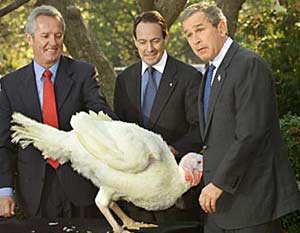
...or whatever it is you enjoy.
In my earlier post I republished several bullet points posted at The Gadflyer by Tom Schaller to explain why he believes this month's mid-term elections vindicated his position outlined in his book, "Whistling Past Dixie". The following is the first installment of my unsolicited, point-for-point rejoinder, adjusted to reflect the corrected criteria outlined in the update to my original post:
1) Schaller says, "5 of 6 gubernatorial pickups outside the South (84%)": True enough. 5 of the 6 new Democratic governors came from outside the south (defining the south as the states that made up the confederacy). In what will be a recurring them here, this analysis ignores, A) the limited number of seats up for grabs in the south in the first place and B) existing Democratic governors in the south.
So yes, 84% of the Democrats' gubernatorial pickups were gained outside the south. At first glance that may look like a very significant figure. However, when one considers that 28 of the 36 governorships contested were also outside of the south (78%) that number looks a lot less impressive. The small variance that does exist between southern and non-southern states here (6%) is not an eye-popping number. It is certainly not large enough to justify conclusions like Schaller's. In fact, one could argue that it actually disproves his point because, at least on a percentage basis, the Democrats' performance in the south is fairly comparable to their results outside of it.
Also, three of the seats in contention in the south were already held by Democrats. This means that any wins in those states (wins they did get, by the way) go by undetected using Schaller's statistic which only measures new "pickups".
Applying a similar methodology to these gubernatorial races, without filtering the results for pickups we find that 3 out of 8 gubernatorial elections held in the south (OK, AR, TN) were won by Democrats (37.5%). Not a majority (yet) but just one win shy of 50%. This hardly qualifies as a blowout.
Furthermore, a quick check of the National Governors Association's website (PDF file) reveals that there were six existing Democratic southern governors. The entries in bold represent seats in contention in this election:When added to the new Democratic southern governor or Arkansas elected Tuesday you arrive at a grand total of 7 out of the 13 southern governorships held by Democrats (54%). Looking at the totality of the data, in what possible way can this be construed as evidence that the Democrats should write off the south as a lost cause?
- Kathleen Blanco (Louisiana)
- Michael Easley (North Carolina)
- Brad Henry (Oklahoma)
- Phil Bredesen (Tennessee)
- Tom Kaine (Virginia)
- Joe Manchin (West Virginia)
2) Schaller says, "5 of 6 senatorial pickups outside the south (84%)": True again but, as is the case above, by narrowing the focus to pickups alone this analysis ignores the limited number of senate seats up for grabs in the south to begin with. The south only represented 4 out of the 16 seats the Democrats could have possibly picked up. Conversely, that means that 12 of the 16 possibilities (75%) were available outside the south so it should come as no surprise that most of the gains also occurred outside the south in a comparable proportion.
By using this statistic Schaller also ignores existing seats already held by Democrats which were retained in these elections. A list of US Senators at the Senate's website shows that there were 2 southern seats already held by Democrats that were in contention this year. They were Bill Nelson's seat in Florida and Robert Byrd's in West Virginia. The Democrats won them both.
Take the Virginia seat acquired by Jim Webb and add it to the 6 total existing democratic seats in the south…
- Blanche Lincoln (AR)
- Mark Prior (AR)
- Bill Nelson (FL)
- Mary Landrieu (LA)
- Robert Byrd (WV)
- John Rockefeller (WV)
…and you end up with a total of 7 out of the 28 seats held by Democrats (25%). Not as strong a figure as the gubernatorial numbers, I'll admit, but hardly a case for giving up on the south altogether. Without these seats there is no democratic majority in the senate for any of us to celebrate over.
(Results culled from CNN)
I'll get back to the Tom Schaller stuff soon enough, but this just has to be posted...
Hersh: CIA Analysis Finds Iran Not Developing Nuclear Weapons
Agence France-Presse
Sunday 19 November 2006
Washington - A classified draft CIA assessment has found no firm evidence of a secret drive by Iran to develop nuclear weapons, as alleged by the White House, a top US investigative reporter has said.
Seymour Hersh, writing in an article for the November 27 issue of the magazine The New Yorker released in advance, reported on whether the administration of Republican President George W. Bush was more, or less, inclined to attack Iran after Democrats won control of Congress last week.
A month before the November 7 legislative elections, Hersh wrote, Vice President Dick Cheney attended a national-security discussion that touched on the impact of Democratic victory in both chambers on Iran policy.
"If the Democrats won on November 7th, the vice president said, that victory would not stop the administration from pursuing a military option with Iran," Hersh wrote, citing a source familiar with the discussion.
Cheney said the White House would circumvent any legislative restrictions "and thus stop Congress from getting in its way," he said.
The Democratic victory unleashed a surge of calls for the Bush administration to begin direct talks with Iran.
But the administration's planning of a military option was made "far more complicated" in recent months by a highly classified draft assessment by the Central Intelligence Agency "challenging the White House's assumptions about how close Iran might be to building a nuclear bomb," he wrote.
"The CIA found no conclusive evidence, as yet, of a secret Iranian nuclear-weapons program running parallel to the civilian operations that Iran has declared to the International Atomic Energy Agency," Hersh wrote, adding the CIA had declined to comment on that story...


