Showing posts with label Democrats. Show all posts

Saturday, March 10, 2007

Washington Hates Democracy

Davida Sirota, in a post entitled "Dems' Big Middle Finger to the American Voter", explains why we all need to be wary of politicians from both parties, particularly when it comes to Iraq (one party more so than another, yes, but still...)

In the Washington Post's solid writeup of the debate over Iraq in the House, a faction of Democrats continues to attack the very Election 2006 mandate they were vaulted into office on: opposition to the war. Justifying her opposition to bills that would stop President Bush's military escalation, we get this from South Dakota's lone House member:

"I don't think we should be overreacting to public opinion polls."


[Snip]

Herseth, of course, is following the tried and true path of fellow politicians and pundits insulated comfortably in the Washington bubble. It was Cheney who said in November that the war "may not be popular with the public - it doesn't matter." It was David Brooks who said a few months ago that "voters shouldn’t be allowed to define the choices in American politics." There was the Bush administration in August of 2006 telling the New York Times "that they are considering alternatives other than democracy" in Iraq - after repackaging the war as an exercise in pro-democracy nation building. The Times itself just recently said that Democrats pushing antiwar legislation strongly supported by the public are "fringe." And let's not forget The New Republic's Peter Beinart who trumpeted groups that - in an oxymoronic backflip - believe "the less beholden politicians are to grassroots activists, the better they will represent voters."

The message from Washington, D.C. to all of us out here in the heartland is very clear: Our government is the exclusive gated community of Big Money interests, their appointed pawns in Congress, and a select group of self-declared "experts" in the media and at think tanks..


The full article is highly recommended reading.

Read more...

Thursday, November 30, 2006

Carter: Peace, Not Apartheid for Palestine

NOTE: I really am composing my follow-up to the Dixie topic, believe me. I just suffer a bit from blogger ADD and all this interesting stuff keeps coming up, like this one.

Former President Jimmy Carter has penned a new book critical of Israel and US policy in Palestine entitled, "Palestine: Peace, Not Apartheid" . With regard to that title I humbly give reference to an earlier post from these very pages on the subject. This is a book I definitely plan to pick up.

Democracy Now! has a post up about the minor controversy surrounding this book. The entry is notable not only for Mr. Carter's viewpoint -- one that is rarely if ever heard in our ostensibly free press -- but also for it's citation of the sharp criticism of those views coming not only from the political right and the usual assortment of Israelophiles collectively known as the "Pro-Israel lobby" but also from the supposed political left in the form of such persons as incoming House Speaker, Nancy Pelosi, and the incoming Judiciary Chairman John Conyers. Check this out...

Former U.S. President Jimmy Carter is accusing Israel of creating an apartheid system in the West Bank and Gaza. The charge comes in his new book "Palestine: Peace Not Apartheid."

The Nobel Peace Prize winner has been deeply involved in Middle East policies for the past three decades. As president he negotiated the Camp David Accords - which secured a lasting peace between Israel and Egypt.

In his new book, Jimmy Carter writes, "Israel's continued control and colonization of Palestinian land have been the primary obstacles to a comprehensive peace agreement in the Holy Land."

Carter criticizes Israel for building what he describes as an imprisonment wall through the West Bank. He accuses Israel of strangling the residents of Gaza where the poverty rate has reached 70 percent and where the malnutrition rate mirrors countries in Sub-Saharan Africa. And Carter is critical of Washington's role. He writes, "The United States is squandering international prestige and goodwill and intensifying global anti-American terrorism by unofficially condoning or abetting the Israeli confiscation and colonization of Palestinian territories."

OK, so you get the gist. Mr. Carter dares to call Israel's policies towards Palestinians and the US government's complicity therein what they really are -- apartheid policies. Per my previous post referenced in the link above, consider the peculiarities of this supposed "lone middle-east democracy". I now repost my citation of Bruce Dixon's "Israeli Apartheid" from The Black Commentator:

Imagine, if you will, a modern apartheid state with first, second and eleventh class citizens, all required to carry identification specifying their ethnic origin. First class citizens are obliged to serve in the armed forces, kept on ready reserve status until in their forties, and accorded an impressive array of housing, medical, social security, educational and related benefits denied all others.

Second class citizens are exempted from military service and from a number of the benefits accorded citizens of the first class. They are issued identity documents and license plates that allow them to be profiled by police at a distance. Second class citizens may not own land in much of the country and marriages between them and first class citizens are not recognized by the state. Second class citizens are sometimes arrested without trial and police torture, while frowned upon and occasionally apologized for, commonly occurs.

Citizens of the eleventh class, really not citizens at all, have no rights citizens of the first class or their government are bound to respect. Their residence is forbidden in nearly nine-tenths of the country, all of which they used to own. The areas left to them are cut up into smaller and smaller portions weekly, by high walls, free fire zones and hundreds of checkpoints manned by the army of the first class citizens, so that none can travel a dozen miles in any direction to work, school, shopping, a job, a farm, a business or a hospital without several long waits, humiliating searches and often arbitrary denials of the right to pass or to return. Posh residential settlements for the first class citizens with protecting gun towers and military bases are built with government funds and foreign aid on what used to be the villages and farms and pastures of the eleventh class citizens. The settlers are allotted generous additional housing and other subsidies, allowed to carry weapons and use deadly force with impunity against the former inhabitants, and are connected with the rest of first class territory by a network of of first-class citizen only roads.

Citizens of the eleventh class are routinely arrested, tortured, and held indefinitely without trial. Political activism among them is equated to “terrorism” and the state discourages such activity by means including but not limited to the kidnapping of suspects and relatives of suspects, demolition of their family homes, and extralegal assassination, sometimes at the hands of a death squad, or at others times by lobbing missiles or five hundred pound bombs into sleeping apartment blocks or noonday traffic. Passports are not issued to these citizens, and those who take advantage of scarce opportunities to study or work abroad are denied re-entry.

The apartheid state in question is, of course, Israel. Its first class citizens are Israeli Jews, the majority of them of European or sometimes American origin. The second class citizens are Israeli Arabs, who enjoy significant but limited rights under the law including token representation in the Knesset. The eleventh class citizens are not citizens at all. They are Palestinians.

And let us not forget the views of Oren Ben Dor, an Israeli citizen who teaches Philosophy at Southampton University's School of Law in the UK. On the recent Isreali demolition of the entire nation of Lebanon he writes...

"What exactly is being defended by the violence in Gaza and Lebanon? Is it the citizens of Israel or the nature of the Israeli state? I suggest the latter. Israel's statehood is based on an unjust ideology which causes indignity and suffering for those who are classified as non-Jewish by either a religious or ethnic test. To hide this primordial immorality, Israel fosters an image of victimhood. Provoking violence, consciously or unconsciously, against which one must defend oneself is a key feature of the victim-mentality. By perpetuating such a tragic cycle, Israel is a terrorist state like no other."

Again, this is an Israeli talking. So, getting back to the DN's coverage of Carter's book:

Some of the most vocal critics of Carter's book have been fellow Democrats. Incoming House Speaker Nancy Pelosi said, "It is wrong to suggest that the Jewish people would support a government in Israel or anywhere else that institutionalizes ethnically based oppression, and Democrats reject that allegation vigorously."

Lets stop right there for a moment and take that in. It is actually "wrong" to suggest that ISRAEL instutionalizes ethinially based oppression? Nancy, dear Nancy, what else would you call it? Ethnicity is literally everything if you live in Israel. I vigorously question the "vigor" with which such a manifestly accurate "allegation" can be rejected.

John Conyers does only slightly better...

John Conyers, the incoming chair of the House Judiciary Committee, urged Carter to change the title of the book, which he described as "offensive and wrong."

What a disappointment! These quotes are incomplete and absent the context of the actual question the speakers may have been asked so I should moderate my criticism some. But taken at face value these statements really bother me. Not because they're suprising. They are not. The power of the Pro-Israel lobby is the stuff of legend and the subject of conspiracy theories the world over. And it is also probably wise for the Democrats, having yet to enjoy their first day at the congressional helm, to avoid picking big fights by co-signing controversial viewpoints at this juncture (regardless of whether or not those viewpoints should actually be controversial at all). Still, this kind of outward attack on Carter's work strikes me as more than avoidance on thier part. Simply withholding an endorsement would have accomplished that. But instead they took that extra step to almost excioriate Carter's valid commentary, virtually ruling out any acknowledgement of the facts on the ground.

As this episode illustrates, in case anyone doubted it, that the power of the "Pro-Israel"* lobby it is quite real. Behold the power of cheese.


* - I say "Pro-Israel" in quotes because that framing implicitly assumes that fairness to Palestinians is "anti-Israel", which it is not. As Mr. Ben Dor argues, the state of Isreal as currently constituted is unsustainable specifially because of it's institutionalized system of ethnic and religious-based injustice. No nation and especially nothing approaching a democracy, can survive a constant state of war, especially if that war is waged against both it's own citizens and it's immediate neighbors. A peaceful and, most importantly, equitable solution to this crisis is the most "Pro-Isreali" stance one can take. The alternative is it's eventual collapse and descent into sectarian and ethnic chaos.

Read more...

Monday, November 20, 2006

Whittling Dixie, Part II

In my earlier post I republished several bullet points posted at The Gadflyer by Tom Schaller to explain why he believes this month's mid-term elections vindicated his position outlined in his book, "Whistling Past Dixie". The following is the first installment of my unsolicited, point-for-point rejoinder, adjusted to reflect the corrected criteria outlined in the update to my original post:

1) Schaller says, "5 of 6 gubernatorial pickups outside the South (84%)": True enough. 5 of the 6 new Democratic governors came from outside the south (defining the south as the states that made up the confederacy). In what will be a recurring them here, this analysis ignores, A) the limited number of seats up for grabs in the south in the first place and B) existing Democratic governors in the south.

So yes, 84% of the Democrats' gubernatorial pickups were gained outside the south. At first glance that may look like a very significant figure. However, when one considers that 28 of the 36 governorships contested were also outside of the south (78%) that number looks a lot less impressive. The small variance that does exist between southern and non-southern states here (6%) is not an eye-popping number. It is certainly not large enough to justify conclusions like Schaller's. In fact, one could argue that it actually disproves his point because, at least on a percentage basis, the Democrats' performance in the south is fairly comparable to their results outside of it.

Also, three of the seats in contention in the south were already held by Democrats. This means that any wins in those states (wins they did get, by the way) go by undetected using Schaller's statistic which only measures new "pickups".

Applying a similar methodology to these gubernatorial races, without filtering the results for pickups we find that 3 out of 8 gubernatorial elections held in the south (OK, AR, TN) were won by Democrats (37.5%). Not a majority (yet) but just one win shy of 50%. This hardly qualifies as a blowout.

Furthermore, a quick check of the National Governors Association's website (PDF file) reveals that there were six existing Democratic southern governors. The entries in bold represent seats in contention in this election:

  • Kathleen Blanco (Louisiana)
  • Michael Easley (North Carolina)
  • Brad Henry (Oklahoma)
  • Phil Bredesen (Tennessee)
  • Tom Kaine (Virginia)
  • Joe Manchin (West Virginia)
When added to the new Democratic southern governor or Arkansas elected Tuesday you arrive at a grand total of 7 out of the 13 southern governorships held by Democrats (54%). Looking at the totality of the data, in what possible way can this be construed as evidence that the Democrats should write off the south as a lost cause?


2) Schaller says, "5 of 6 senatorial pickups outside the south (84%)": True again but, as is the case above, by narrowing the focus to pickups alone this analysis ignores the limited number of senate seats up for grabs in the south to begin with. The south only represented 4 out of the 16 seats the Democrats could have possibly picked up. Conversely, that means that 12 of the 16 possibilities (75%) were available outside the south so it should come as no surprise that most of the gains also occurred outside the south in a comparable proportion.

By using this statistic Schaller also ignores existing seats already held by Democrats which were retained in these elections. A list of US Senators at the Senate's website shows that there were 2 southern seats already held by Democrats that were in contention this year. They were Bill Nelson's seat in Florida and Robert Byrd's in West Virginia. The Democrats won them both.

Take the Virginia seat acquired by Jim Webb and add it to the 6 total existing democratic seats in the south…

  • Blanche Lincoln (AR)
  • Mark Prior (AR)
  • Bill Nelson (FL)
  • Mary Landrieu (LA)
  • Robert Byrd (WV)
  • John Rockefeller (WV)

…and you end up with a total of 7 out of the 28 seats held by Democrats (25%). Not as strong a figure as the gubernatorial numbers, I'll admit, but hardly a case for giving up on the south altogether. Without these seats there is no democratic majority in the senate for any of us to celebrate over.

(Results culled from CNN)

Again, although these figures show that the Democrats have some work to do in the south they don't represent a compelling case for giving up on that work altogether. In this election in particular we've been given a good reason to think the opposite approach is appropriate.

Underscoring this point is this glaring factoid: No defending Democratic governor or senator lost his/her re-election bid this year; not in the south or anywhere else. Not a single vacated governorship or senate seat previously held by a Democrat was won by a Republican. Absolutely every single instance of turnover in this election happened at the expense of Republicans in both the south and elsewhere. The disaffection with the GOP is a nationwide trend. Any call for the Democrats to intentionally squander that opportunity in the south or anywhere else is just plain crazy bordering on suicidal.

There are now 7 of Schaller's bullet points to go. I will press on further in future posts…

Read more...

Saturday, November 11, 2006

Whittling Dixie

Tom Schaller speaks! Responding in The Gadflyer to Joshua Holland's post, which echos many of my critiques of Schaller's Whistling Past Dixie, Schaller offers the following bullet points to explain why this election vindicates his position:

Sure, we can cherry pick here and there to find southern wins. And I never said there would never be southern wins at any level, ever again.

But let's look at this week's results through some quick bullet points:

  • 5 of 6 Gubernatorial pickups outside the South (84%)
  • 5 of 6 Senatorial pickups outside the South (84%)
  • 24 of 29 House pickups outside the South (83%)
  • Speaking of the House, here are the "flip" rates for each region (and I include KY and OK with the Confederate South, to keep Josh happy): Northeast: 11 wins from 36 GOP-held seats, or 30.6% "flip rate"; Midwest: 9 of 60, 15%; 4 of 44, 9.1%; but in the South, just 5 of 91, for a meager 5.5%.
  • And of those 5 southern wins, two were in races that were tainted by deposed incumbent scandals, and required voters to write-in the GOP candidate (and they still were close).
  • For the first time in more than half a century, the minority party in the South is the majority party in both chambers of Congress--a truly stunning development.
  • 254 of 275 net new Democratic state legislators (92%) outside the South, the vast majority coming from the Northeast and Midwest, yielding nine new chamber majorities (six in the Midwest, one in Oregon, both in New Hampshire…none in the South).
  • The measly 21 southern state legislative seats the Democrats netted are only 1 fewer than the combined 20 U.S. House seats the Democrats picked up in the Midwest and Northeast alone.
  • Finally, here is the two-party Democratic (D%-R%) performance, by region, according to exit polls: Northeast, +28%; Midwest, +5%; West, +11%; and South, -8%.

In my next few posts I'll be taking these on point for point. I think dealing with it all at once would result in a post of prohibitive length so please bear with me.

Read more...

Thursday, November 09, 2006

Whistling Through (NOT past) Dixie

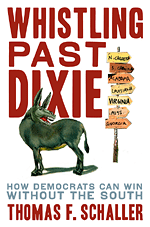
With Tuesday's long-overdue and merciful election results now a reality some of the folks on The Gadflyer -- a blog I really enjoy reading, just so you know I'm not sniping at them -- have taken this as an opportunity to unite in praise of one Tom Schaller, author of Whistling Past Dixie: How the Democrats Can Win Without the South.

Before I begin with my reservations about that, I have to preface my comments with the admission that I have not read that book. I have only read commentary about it. So, if any suppositions I make here are an inaccurate or incomplete representation of Mr. Schaller's position, I apologize in advance and invite the opportunity to be corrected.

However, if the commentary I've read both from supporters and critics alike is accurate, Schaller's main argument seems to be that the south is so far out of reach for the Democrats that they have no reasonable expectation of making any headway there anytime soon. As such they should concentrate their efforts on the rest of the country and pretty much write the south off.

Now the good people at The Gadflyer are touting Tuesday's election as a vindication of that strategy with one contributor even adding that it all certifies Schaller as brilliant. Now, I have no intention of questioning Mr. Schaller's expertise on this subject nor his intellect. But I think before we heap this kind of praise on him for this particular work we should take a closer look at what really took place Tuesday.

From where I'm standing, far from being any vindication of the idea that the Democrats should regard the south as a dead zone, the exact opposite seems to be true. Consider the following:

First, much of south was off the table for this election so it's difficult to use this a gauge with which to judge claims the Gadflyers are making. In the Senate only four of the 14 states that would traditionally be considered "the south" (south of the Mason-Dixie line -- DIXIE!) were contested at all. And a quick examination of the red/blue map shows that there is a fair share of blue in that same region.


Arkansas, the state that elected Bill Clinton to two gubernatorial terms:
  • 3 out of the four seats up for grabs were won by Democrats. The state was an incumbent sweep in districts that were not competitive, however. Still, 3 out of 4 ain't bad.
  • In the race for governor Democrat Mike Beebe defeated former DEA chief, Asa Hutchinson, handily 55-41%.

Alabama:

Bad juju.


Florida's senate and key house races:
  • Democratic Senator Bill Nelson trounced Katherine "Voter Purge" Harris.
  • Democrat Tim Mahony won the seat vacated by disgraced Rep. Mark Foley.
  • GOP candidate Vernon Buchanan barely edged out the Democrat Christine Jennings by less than a single percentage point.
  • DemocratRon Klein defeated incumbent Republican Eugene Shaw by 4-points.

Georgia:
  • 6 of the 13 seats up for re-election were won by Democrats.
  • In a key race the Democrat John Barrow defeated the Republican Max Burns in the 12th district
  • Incumbent Democrat Jim Marshall held off challenger Mac Collins in another key race
  • No key races were won by republicans in Georgia, of all places.

Kentucky:
  • A key race in KY's 3rd district was won by a Democrat, John Yarmouth, over a Republican incumbent, Anne Northrop.
  • Democrats only won 2 of the seats contested here but, obviously, one of them was in a pivotal race against a long-time GOP incumbent.
  • This is Kentucky I'm talking about here. It so southern there's literally no way to even pronounce it's name without sounding southern yourself. I dare you to try!

Louisiana:

The Dems didn't win a majority of the seats here, taking only 2 of the 7 seats but, once again, they took the one that mattered -- the "key race" in the 2nd district holding on to a seat already held by the embattled incumbent William Jefferson. So you see the first sign that embattled Republicans are getting ousted while similarly situated black Democrats can hold on even in the deep south state of Louisiana.


Maryland:
  • Ben Cardin handily defeated the highly-touted Republican Michael Steele for that state's vacant senate seat.
  • Democrat Martin O'Malley won in a strong showing against incumbent governor Robert Ehrlich.
  • None of Maryland's house races were pivotal in the determining the balance of power but still, 6 of the 8 seats were won by Democrats.

Mississippi:

Not much action here but the house seats up for grabs were split 50/50 and Republican Trent Lott retained his senate seat as expected.


North Carolina:
  • In the only race seen as "key", Democrat Heath Shuler soundly defeated the Republican incumbent Charles Taylor by an eight point margin, representing what I believe is his first win since leaving the Vols.
  • 6 of the 12 seats contested were won by Democrats.

Oklahoma:

Not much good here. One Democratic incumbent won in a heavily Democratic district. But even that fact alone also helps my point. There are heavily democratic districts in every state in the union. Build on that.


South Carolina:

What can I say? It's South Carolina. I never said this thing was going to be easy. Still again, two Democratic incumbents won in heavily Democratic districts that actually exist in South Carolina.


Tennessee:
  • In the race for Bill Frist's Senate seat Harold Ford, Jr -- a black man in Tennessee, shamelessly attacked by race-baiting opponents with thinly veiled references to "the taboo", fell to his Republican opponent but made a strong showing in the heart of Dixie by bringing in 48% of the vote.
  • The incumbent Democratic governor, Philip Bredesen, handily defeated his Republican challenger, Jim Bryson, by 39% of the vote.
  • None of the house races in this state were thought to have a major impact on the balance of power but it is telling that the Democrats won 5 of the 9 seats up for grabs.
  • This is Tennessee I'm talking about, people.

Texas:
  • Texas is Texas. This is the state that is mostly responsible for the Bushit we put up with today. Yesterday they also gave us another 6 years of Kay Baily Hutchinson.
  • 12 out of 32 House seats went to Democrats but, as we all know, this state was gerrymandered out the whazoo a couple of years back.
  • Despite all of this, once again ij the race that mattered the Dems broke through with Nick Lampson taking the Sugar Land seat vacated by the slimey yet disturbingly popular, Tom Delay.

Virginia:
You all know by now that an incumbent Republican senator with Presidential aspirations was narrowly ousted by the Democratic challenger, Jim Webb, with the fate of the Republican congress hanging in the balance. Nuff said.
West Virginia:

  • Democratic incumbent Senator Robert Byrd retain his seat as expected.
  • The state was an incumbent sweep with Democrats retaining 2 of the 3 seats contested.

In addition to the above results the Dems took seats that looked all but lost until recently in the old border states like Indiana, Missouri and Kansas plus the big sky state of Montana -- states that are not technically "the south" but share a lot in common with it politically.

Taken altogether I'm missing the part where these results constitute any compelling argument that the Democrats should write the south off. If anything the exact opposite seems true. One can talk all day about historical results, polling data and high-end political calculus. But this election appears to me to be, if anything, a stunning vindication of at least the idea behind Howard Dean's 50-state strategy for rebuilding the Democratic party.

Make no mistake about it. "Whistling past Dixie" is not a new idea nor is it a good one. It is essentially what the Democrats have done for much of the past 30 years -- sometimes consciously and other times not -- and all it has earned them is a shrinking political footprint in a nation where the vast majority of Americans agree with their policy positions on most of the issues. Simply put, it's a non-starter. It's absolutely crazy to advocate growing the party by relegating it to a semi-national or regional status with a publicly enunciated strategy to ignore the south. This is especially true considering there are so many natural reasons for southerners to support you if you'd only get out there and show them why.

More importantly, the spectacle of even talking about writing the south off (let alone actually doing it) could have the lethal effect of validating all the right-wing rhetoric about Democrats being elitist, "northeastern liberals" who don't care about the "real Americans" in the south (and extended into "the heartland"). The GOP will be free to paint them all as snobs looking down their noses at middle and lower income constituencies that reside there. This is exactly the wrong the message to send.

Meanwhile, the GOP will be attacking you on every front on every square foot of this nation, all over the country, not just in the south. What could be more suicidal than to adopt this reverse southern strategy?

Now, I'm not saying that succeeding in the south on a consistant basis is going to be an easy thing for the Democrats to accomplish. But simply giving up on it altogether seems to me to be the easy and foolish way out. A national party competes nationally.

Note: I would have liked to have posted my thoughts on this in the comments section at The Gadflyer but, unfortunately, they don't seem to have one.


UPDATE:

I just got my first celebrity response in the comments section this past Friday from Joshua Holland of Alternet and The Gadflyer. In the words of Peoples Hernandez, "We got Hollywhoo!"

Mr. Holland pointed out that "Schaller specifically limits his analysis to the eleven states of the confederacy", not the broader south-of-the-Mason-Dixon Line analysis I'm using here. I will make the proper adjustments now while making note of one important objection -- there are more than 11 states that were part of the confederacy.

Maryland is out: It truly wasn't a confederate state and is considered by all a border state despite it's south-of-the-Mason-Dixon-Line geography. However, even after correcting this my point doesn't change a great deal. Maryland is the only non-confederate state I've included here and, although the great gains made there did help my argument, it was just a bonus. Move my reference to it to the paragraph on border states instead and everything is all hunky-dory.

West Virginia stays: Although there was no state of West Virginia in the confederacy there was the old state of Virginia. A quick peek at a Civil War era map of Virginia seals the deal:


Look at little fat? That excess you see to the west is none other than West Virginia, which was part of the state of Virginia at the time of its secession from the union – a bona fide part of the Confederacy. West Virginia stays.

Oklahoma stays: Although Oklahoma was technically Indian Territory during the civil war, any analysis of the American south that includes Texas but excludes Oklahoma would strike me as particularly meaningless. Let's hope this is not what Schaller has done.

Finally, if we look at the confederate criteria technically I should have included Missouri. However, to avoid the appearance of gratuitously taking advantage of the situation, I'll continue to exclude it.

Read more...