Showing posts with label Israel. Show all posts

Sunday, June 10, 2007

News & Notes

Miscellaneous items of note:

Empire Burlesque: Seasons in Hell: Voices From the American Gulag

The Independent has a remarkable story on Sami al-Haj, the Sudanese journalist who has been held in George W. Bush's concentration camp in Guantanamo Bay for five years. Haj has not been charged with any crime, but he is undoubtedly guilty of a grave sin in the eyes of the Bush Regime: he is a cameraman for Al Jazeera.


Orcinus: Ron Paul vs The New World Order
I have to admit that when Rep. Ron Paul announced his candidacy for the Republican presidential nomination, I didn't raise much of an eyebrow, even though I am a longtime Paul watcher. After all, he's run before; his 1988 Libertarian Party candidacy attracted little attention because he ran mostly from the fringe, and his views haven't changed substantially over the years.

What I didn't expect was that his anti-war advocacy would attract as many evident admirers from the left as it seems to have, particularly those who are dissatisfied with Democrats' apparent fumbling of the Iraq war issue. Certainly, the message boards at liberal outlets like Crooks and Liars who've carried factual counterinformation about Paul have been flooded with raging defenses of the man, as have some of our comments threads.

To what extent this is an illusion created by Paul's legion of True Believers is difficult to ascertain. Paul is very well organized online -- much of his support is derived from this -- and it's entirely likely the flood of "liberals" and "progressives" who are busy arguing that someone like Paul is worth forming an alliance with are, in fact, simply part of Paul's corps and they're doing their part to muddy the waters and ultimately attract new supporters in a "Third Way" kind of strategy.

And to some extent it seems evident that they're succeeding. Mostly, they seem to be taking advantage of a combination of amnesia among those experienced enough to know better, and simple ignorance on the part of progressives who've never heard of, or paid any attention to, Ron Paul previously. They hear Paul's carefully crafted antiwar rhetoric and his critique of the Bush administration -- all of which elide or obscure his underlying beliefs -- and think it sounds pretty good, especially for a Republican.

As Sara has already explained, there's a real problem with that -- namely, for all of Paul's seeming "progressive" positions, he carries with him a whole raft of positions well to the right of even mainstream conservatives.


Does any of the following sound familiar?

Chris Hedges: Looking Back on 40 Years of Occupation
Israel captured and occupied the Gaza Strip and the West Bank 40 years ago this week. The victory was celebrated as a great triumph, at once tripling the size of the land under Israeli control, including East Jerusalem. It was, however, a Pyrrhic victory. As the occupation stretched over the decades, it transformed and deformed Israeli society. It led Israel to abandon the norms and practices of a democratic society until, in the name of national security, it began to routinely accept the brutal violence of occupation and open discrimination and abuse of Palestinians, including the torture of prisoners and collective reprisals for Palestinians attacks. Palestinian neighborhoods, olive groves and villages were, in the name of national security, bulldozed into the ground.


Lastly, on "Force labor", formerly known as slavery...

Inter Press Service: IRAQ: Blood, Sweat and Tears at New U.S. Embassy
The U.S. Justice Department is actively investigating allegations of forced labour and other abuses by the Kuwaiti contractor now rushing to complete the sprawling 592-million-dollar U.S. embassy project in Baghdad, numerous sources have revealed.


Read more...

Sunday, March 11, 2007

The "Right to Exist"

As alluded to in previous posts, much is made of the state of Israel's "right to exist" and I have called into the question whether it really is Israel whose "right to exist" is genuinely threatened. But there's another weakness in this framing of the conflict that I neglected. The entire argument is nonsensical on its face. In a piece in the Los Angeles Times today entitled, Why Does The Times Recognize Israel's 'Right to Exist'?, Saree Makdisi thrashes the nail soundly about the head:

First, the formal diplomatic language of "recognition" is traditionally used by one state with respect to another state. It is literally meaningless for a non-state to "recognize" a state. Moreover, in diplomacy, such recognition is supposed to be mutual. In order to earn its own recognition, Israel would have to simultaneously recognize the state of Palestine. This it steadfastly refuses to do (and for some reason, there are no high-minded newspaper editorials demanding that it do so).

Second, which Israel, precisely, are the Palestinians being asked to "recognize?" Israel has stubbornly refused to declare its own borders. So, territorially speaking, "Israel" is an open-ended concept. Are the Palestinians to recognize the Israel that ends at the lines proposed by the 1947 U.N. Partition Plan? Or the one that extends to the 1949 Armistice Line (the de facto border that resulted from the 1948 war)? Or does Israel include the West Bank and East Jerusalem, which it has occupied in violation of international law for 40 years — and which maps in its school textbooks show as part of "Israel"?

For that matter, why should the Palestinians recognize an Israel that refuses to accept international law, submit to U.N. resolutions or readmit the Palestinians wrongfully expelled from their homes in 1948 and barred from returning ever since?

If none of these questions are easy to answer, why are such demands being made of the Palestinians? And why is nothing demanded of Israel in turn?

Orwell was right. It is much easier to recycle meaningless phrases than to ask — let alone to answer — difficult questions. But recycling these empty phrases serves a purpose. Endlessly repeating the mantra that the Palestinians don't recognize Israel helps paint Israel as an innocent victim, politely asking to be recognized but being rebuffed by its cruel enemies.

Actually, it asks even more. Israel wants the Palestinians, half of whom were driven from their homeland so that a Jewish state could be created in 1948, to recognize not merely that it exists (which is undeniable) but that it is "right" that it exists — that it was right for them to have been dispossessed of their homes, their property and their livelihoods so that a Jewish state could be created on their land. The Palestinians are not the world's first dispossessed people, but they are the first to be asked to legitimize what happened to them.

Imagine that. Palestinians are being asked to "recognize" an entity that wont return the favor and wont even go so far as to fully define what it is they wish to have recognized -- it's own borders. Meanwhile it's teaching its children that the land Palestinians are standing on is already part of Israel. I suppose that explains what we see in this map and this one. Nice.

Whose right to exist is really in danger here?

Read more...

Sunday, February 11, 2007

Palestine & Apartheid


Is there any space left for Palestians?Whenever the subject of the Israeli/Palestinian conflict is raised much is made of what is called "Israel's right to exist" and the justification for its actions in light of this right. But much less is made of either the Palestinian right to exist or the fact that Israel is largest military power in the "middle-east" region today while Palestine has no military to think of. With that in mind, a brief glance at the map of Israeli settlements into Palestinian territory since 1967, pictured here, gives a clear picture of exactly whose existence is truly imperiled.

After studying this map closely imagine if someone decided to build a system of long continuous walls for the purpose of cutting off the most valuable of these areas represented by the red dots from the rest of the country, like so (the brown part goes to Israeli settlers in this scenario):


What kind of viable, livable, autonomous and sovereign country would be left for Palestinians? Who really faces an immediate existential threat?

Via The Black Commentator comes this relevant follow up to the previous posts on Palestine and Apartheid...

At a 1 December 2006 Palestine Center briefing, William Fletcher discussed the similarities and differences between Israeli-occupied Palestine and apartheid-era South Africa focusing on the logic, objectives and strategy of settler states. He also addressed the opposition to Jimmy Carter's new book, Palestine Peace Not Apartheid, and urged a continued mobilization around the issue of Palestine.

“Two Walled Cities: Jerusalem and Johannesburg, Apartheid and Palestine”
Transcript of Remarks by William Fletcher
“For the Record” No. 269 (19 December 2006)

Thank you and it’s an honor and a pleasure to be here.

When I was invited, I was asked to speak in terms of what was called “Two Walled Cities: Jerusalem and Johannesburg.” I thought that was a very good metaphor to look at the issue of apartheid and the occupation. But before but I get into that, I want to preface it by actually
speaking about some differences between Israeli-occupied Palestine and apartheid-era South Africa, in fact, a very dramatic difference.

Within a few months of my taking over as President of TransAfrica Forum in January 2002, I received a call from none other than the Israeli Embassy congratulating me on the appointment. This came as an incredible shock. I said to myself, do they know who I am? They then went on to propose a meeting with me to discuss a cultural program that the Israeli Embassy wished to jointly sponsor with TransAfrica Forum that focused on Ethiopian Jews. The meeting never
happened. They called me and claimed that someone on their staff had gotten sick. I guess they’re still sick because the meeting was never rearranged. But in any case, I concluded that they probably did a little investigation and just said that there wouldn’t be much of a point to having the meeting.

I raise this for two reasons. One is that I never received a congratulatory call from an Arab Embassy. And this is not an attack on Arabs, but it is something I’ve noticed in terms of the unwillingness or inability to carry out outreach in the USA in order to promote an Arab viewpoint. The Israelis, on the other hand, are phenomenal in terms of outreach. The South Africans during the apartheid era were not. I’ll get into that in a second, and it’s a very, very big difference in the approaches of the two countries. So the approach of the Israelis really does contrast remarkably with the approach that the South African apartheid regime took towards the whole notion of developing allies and constituencies externally. The Israelis have always had an active outreach program, and while they have consistently portrayed themselves to be victims, they have done so in a way that constantly seeks international support. Interestingly, other settler states like South Africa and Australia took a very, very different view when it came to this matter and did not, by and large, seek non-governmental constituencies, even though both of these other settler states, in their own ways, portrayed themselves as victims. The South African apartheid regime obviously had a close alliance with the United States but did not spend a lot of time trying to cultivate a relationship in the United States. The slight exception to this was the effort, backed by the Reagan administration, to promote the South African-aligned Angolan movement of Jonas Savimbi (called the National Union for the Total Independence of Angola [UNITA]) in the USA in connection with certain right-wing African American churches. Even here, however, while UNITA was aligned with South Africa, it was not the South Africans who were trying to develop a constituency in the USA.

The logic of both Israel and apartheid-era South Africa can be found in their common origins as settler states. In both cases, the settlers created myths, semi-religious or explicitly religious, including that God had provided the land for them and that the land was unoccupied upon arrival, a very, very common theme in every settler state, whether it’s the United States, Israel, Australia, New Zealand, Canada, etc. In both cases, the settlers portrayed themselves to be victims against natives who were described as
semi-barbaric and/or intolerant. Given the permanent state of siege, every settler state aggression came to be described as a defensive act, an approach also common with the United States. By way of example, for South Africa, incursions into Angola, Mozambique, Zimbabwe or anywhere else always against alleged terrorists were justified as alleged defensive actions.

For the settler state, there is a zero sum calculation when it comes to the natives. This does not necessarily mean that the natives must be annihilated, but it does mean that the natives can never be allowed to prevail. In this context, one can look at Jerusalem and apartheid-era Johannesburg as emblematic of settler strategy and the settler state as a whole. Though there are significant differences between Israel and apartheid-era South Africa, for example, the religious significance of Jerusalem, the settler approach in both cases with these cities shared much in common. In the case of Jerusalem, the entire city has been
seized by the settlers who have no intention of sharing it with the Palestinians. The settler plan is one of driving out the Palestinians through a combination of intimidation and inconvenience, otherwise known as psychological warfare. By inconvenience I mean the painful difficulties encountered by Palestinians living in occupied East Jerusalem.

Johannesburg, however, was constructed to be for whites only. Blacks could enter the city
during the days to work but had to clear out at nightfall unless they had explicit permission to stay. Blacks lived in what can only loosely be described as suburbs or townships, the most well known being Soweto, which is an acronym for South-West Township. It’s not a name in and of itself. Security, as in occupied Palestine, was ever present in Johannesburg and Soweto. Blacks carried passes and travel was always limited. Johannesburg stood as a top of the line First World city while townships like Soweto were Third World and often-quite marginal.

The walls in the case of Johannesburg were actually around Soweto and other townships as opposed to being around Johannesburg itself. In fact, one of the remarkable things in going to Soweto is that there is only one road and gate in and out. As apartheid crumbled, so too did much of Johannesburg. Whites left the city in mass and they abandoned their often-luxurious high rises to squatters or general squalor. They retreated to their nearly always heavily militarily guarded and gated communities. And there was a remarkable reversal that unfolded. Whites would be in the city by days, and then they would be in their communities at nights. But they would not stay in Johannesburg during the evening.

The apartheid plan was for the removal of blacks from the best of land. In this case, it followed the model that was established by the British in Ireland in the 1500s when they drove the Irish out of the best lands in the north and forced them south and settled the north with Welsh, Scots and some poor English. It also follows what we see in other settler states, such including the
United States, Canada, Australia, New Zealand and obviously Israel.

Yet each settler state has handled its indigenous population somewhat differently. In Australia,
New Zealand and the United States, there was an overt effort at extermination. Case in point, there are no Tasmanians left on this planet. Not only were the indigenous removed from the land, they were removed from the living. In Ireland, South Africa and to some extent Canada, the premium was placed on the removal of the natives from the land and their socio-political marginalization. In the case of Palestine, I’d argue, a bit of both seems to be underway, though the emphasis seems to be on the removal from land.

In both the Occupied [Palestinian] Territories and apartheid-era South Africa, the settler state wishes (or in the case of South Africa, wished) to make the situation so inhospitable that the indigenous people leave on their own. It combines violent coercion with what can be described
as hassling, or what I said earlier, psychological warfare. In the case of South Africa, the apartheid regime created those fictitious homelands like the Transkei and Ciskei. These were actual large territories with limited resources and limited anything with the exception of sources of entertainment such as Sun City. The key land always remained in the hands of the whites. The Occupied [Palestinian] Territories are replicating this pattern. And just as the apartheid regime presented itself to the world as visionary by allegedly “liberating” the homelands, so too do the Israelis in their vision of a Palestinian state or statelet. The situation raises some uncomfortable strategic questions. For the black South Africans, the struggle was not one to build legitimate and self-sustaining homelands. The objective was not to take over the Transkei and Ciskei and make those viable states. It was instead to destroy apartheid and create a democratic South Africa. In that sense, it’s interesting to see discussions under way in the Palestinian movement regarding the viability of the two-state solution in light of what Israeli practice has been.

Finally, the Holocaust separates Israel from apartheid-era South Africa largely in terms of the perspective of the rest of the world. The treatment received by the Boers (what are now known as Afrikaaners), in the original British concentration camps during the Anglo-Boer war, may have helped to shape Afrikaaner consciousness, but it had little impact on the way that the rest of the world viewed the Boers as a people or their efforts to eventually justify the apartheid state. The Holocaust, however, shuts down much discussion. This is not helped by comments such as the contradictory and rhetorically provocative, if not stupid, statements by the Iranian President [Mahmoud] Ahmadinejad questioning the reality of the Holocaust. Yet the Holocaust, a horrific act committed by one group of Europeans against another, is presented in a white supremacist framework in order to trump any and all discussions regarding Palestinian sovereignty and the legitimacy of any settler state.

The struggle against apartheid carried with it many valuable lessons for the Palestinian movement. Yet I would suggest that the struggle of the First Nations, or the Native Americans (here in the USA), also carries invaluable lessons. The First Nations in the United States and Canada were demonized, dehumanized and, ironically, romanticized by the settler state. The settler myth was used to justify continuous expansion, the breaking of treaties, murder and land removal—actually the removal of the people from their land. The settler state justified its atrocities by reference to what eventually came to be known as the “facts on the ground.” In other words, from the standpoint of the settler, it does not ultimately matter whether ‘we’, that is the settler, robbed ‘you’ of your land and dignity. ‘We,’ meaning the settler, possess all the cards. That is, the settler possesses all or most of the weapons and, therefore, from the standpoint of the settler, the game is over and, as the bumper
sticker says, “Things just happen.”

Thank you...

William Fletcher is Belle Zeller Visiting Professor at Brooklyn College-City University of New York and former President and Chief Executive Officer of TransAfrica Forum, a national non-profit organization organizing, educating and advocating for policies in favor of the peoples of Africa, the Caribbean and Latin America.

This “For the Record” transcript may be used without permission but with proper attribution to The Palestine Center. The speaker's views do not necessarily reflect the views of The Jerusalem Fund.

To read the question and answer session that followed Mr. Fletcher's speech, click here.

Read more...

Saturday, February 03, 2007

Carter Defends "Peace, Not Apartheid"


The awful truthI'm a little late posting this one but it's worth a look anyway. Former President Jimmy Carter appeared on NPR recently to defend his new book, Palestine: Peace Not Apartheid. Carter has predictably come under attack from supporters of Israel's government and its policies over his use of the term "Apartheid". Carter defends himself well against these attacks and certainly doesn't seem to need my help. But, as you listen to the interview in its entirety (I highly recommend that you do) consider how instructive this whole episode is on the nature of the Israel/Palestinian debate in America.

Carter presents a valid and important argument that for years has been considered fairly obvious outside of the United States. In fact, as has been noted elsewhere, he may not have gone far enough, censoring himself as a preemptive measure against these kinds of attacks. For instance, Carter insists in the NPR interview that nothing in his book suggests that Apartheid is practiced inside of Israel but that it is very much the case in the Palestinian territories Israel occupies. He bends over backwards (too far, in my opinion) to portray the domestic policies of Israel as democratic and fair, limiting his critique to it's behavior in Gaza and the West Bank.

Nevertheless, inside the US he is being vilified as, of all things, an anti-Semite, consistent with the well-worn construct that any criticism of Israel's government, regardless of its accuracy, is tantamount to launching a second Holocaust. In the firestorm that has erupted Carter's main point -- that peace is impossible if the legitimate, long-standing grievances of the Palestinian people continue to be ignored and literally paved over -- is completely obscured by all the hand-wringing over the use of the word "Apartheid".

In observing any debate, even if one is not up-to-speed on the issue at hand, there are things one can look for in order to ascertain which side is being, shall we say, less-than-candid and which isn't. And the Lord said "Ye shall know them by their fruits".

The fruits in this case are the methods used by Carter's critics to carry their side of argument, the vast array of intentional fallacies designed to obscure the weakness of their position. Using these techniques they have managed to remove the merits of his arguments from the discussion completely. From their perspective there is a good reason for this. Carter's arguments are unassailable. So, instead they've chosen obfuscation and fallacy as their primary weapon, focusing on a single word as a springboard for ad hominem attacks and straw man arguments.

With these tools they've managed to create a media environment in which all the focus is on whether Israel is exactly like South Africa, or whether Carter is anti-Semitic. These are, of course, wholly irrelevant but they serve the purpose of diverting attention away from facts that, again, are already considered well-established in the rest of the world but don't serve the interest of continuing the status quo.

These cynics are aided in no small part by the US media's long-standing embargo against any suggestion that Palestinians are rational human beings who are actually suffering unjustly under a 40-year Israeli occupation that denies them the basic human rights and dignity we ourselves insist upon. Only in such a media environment, built on a foundation of fallacy, can a situation in which the land is being literally pulled out from under the Palestinians' feet, where Palestinians are literally being walled off from their own homes, workplaces, families and assets be described as a threat to Israel's existence and not that of the Palestinians.

I have long argued privately that the use of such tactics represents an tacit admission by the user not only that their argument is weak on merit but that they know it and don't care. They don't want peace. They want Apartheid and they'll say anything to keep it. They'd just prefer you call it something else.

See also:

Carter Wins Applause at Brandeis

Read more...

Sunday, January 07, 2007

Report: Israel Planning Nuclear Strike


The Sunday Times of London is reporting that Israel is planning a nuclear strike against Iran's nuclear enrichment facilities. The strike is described as involving conventional nukes to open a tunnel underground after which "tactical" nuclear weapons (that's "weapons", with an 's') are to be used to destroy the facilities.

Israel has already issued a denial of the report.


An aside: If you do a Google or Yahoo news search on this story using the terms "Israel plans nuclear Iran", for example, you'll find that the overwhelming majority (if not all) of the stories covering the original report on these plans come from media sources outside of the US. But the US media is well represented in the list of stories detailing Israel's denial of the report. I though that was interesting.

These "tactical" nukes are said to have about 1/15th of destructive force of the atomic bombs used on Hiroshima and Nagasaki and the desired underground detonation is designed to limit the risk of nuclear fallout. There now, that's comforting, isn't it?

In light of the Israeli government's denials, I would be remiss if I didn't point out an earlier post on these pages where I noted Dick Cheney's foreshadowing of these very events...

Over a year ago Vice President Dick Cheney foreshadowed the end-game:

"Well, one of the concerns people have is that Israel might do it without being asked, that if, in fact, the Israelis became convinced the Iranians had significant nuclear capability, given the fact that Iran has a stated policy that their objective is the destruction of Israel, the Israelis might well decide to act first, and let the rest of the world worry about cleaning up the diplomatic mess afterwards."

That sounds so much like a tacit recommendation cloaked in plausible deniability that I just can't stand it. But one could argue that he didn't mean it that way at all. After all, that's what plausible deniability is all about.

But Thursday, President Bush gave us the confirmation and removed all doubt. In the same press statement cited here earlier, where he described this as "American policy", he also said:

And now's the time to address the root cause of the problem, and the root cause of the problem is terrorist groups trying to stop the advance of democracies. Hezbollah attacked Israel. I believe Hezbollah -- I know Hezbollah is connected to Iran. And now's the time for the world to confront this danger."

That's where this is going. That's what this is all for. All the rest is pretext. Israel is initiating a plan drawn up by us to facilitate a military strike, possibly a nuclear one, on Iran. This is the latest great event that we will be asked to believe will revolutionize the middle-east for the better. It is an apocalyptic vision bathed in blood. What's worse, it will fail and it will backfire on all of us. God help us all.

The point still stands.

Read more...

Monday, January 01, 2007

It's an Occupation, Not a War


Every now and then I find myself in "enemy" territory.

For instance, I was invited to a small New Year's Eve gathering by some relatively new acquaintances. I understand that many of my views are hard for some folks to swallow at first glance. They cut against the "mainstream", nightly news grain so I don't walk into new environments with pistols blazing or anything. But sometime during the football game the subject of Iraq came up because of Saddam's execution -- it wasn't me, I promise. The reaction of the people there was one of celebration on the one hand and disgust that Muslims could possibly have any complaints about it on the other. So, right then and there it was clear. This is not my target audience -- but maybe they should be.

Anyway, I have nothing against these folks. They seemed damned decent to me and I liked them. They didn't strike me as partisan political junkies at all. They were ordinary folks who, like anyone else, were reacting to the news of the day. But the conversation was peppered with vintage BushCo talking points despite the fact that I didn't get the feeling these were rabid Bush supporters. Still, they were riding the "fight them there so we don't have to fight them here" horse like Willie Shoemaker. That stuff is like horseradish or dirty diapers to me -- damned near impossible to ignore. It's hard to let that stuff go unanswered.

My opening came when one of the guests mentioned that our involvement in the war was now longer than our involvement in World War II. That factoid seemed to surprise some of the others in the room and that gave me the opportunity send up my trial balloon.

"That's true," I said, "but when you really think about it, it's not really a war so much as it is an occupation," I offered helpfully.

"I mean, there's not really a line of troops with tanks, air support, attack chopper and gunships facing our guys over there," I added.

I finished it off with what I admit was a bit of superficial rhetorical camouflage, "So, if you look at it in terms of other occupations, it's not really that long at all."

Everyone reacted positively to that one, to my pleasant surprise, agreeing that it was more like an occupation than a hot war like WWII or even Vietnam.


Seed Planted

The distinction between war and occupation is an important one when it comes to people's perception of our involvement in Iraq. The Bush administration seems to realize that as long as they can keep the public locked into the war paradigm they can still kick up little dust-bunnies of support for their program. Their well-worn assortment of schoolyard taunts, accusing critics of wanting to "cut & run" or "appease the enemy" are just enough to earn them at least the grudging support of an American public that feels obligated to back their country in a war, right or wrong.

But something happened in that room when I managed to get people to acknowledge the true nature of what's happening in Iraq. Once they accepted the idea of it being an occupation instead of a war all the talk of "victory" ended abruptly. Now, one might suspect that this happened because I'd made them uncomfortable, but I don't think so. That's not the feeling I got. What I think really happened is that everyone realized that you can't win an occupation the way you can win a war.

So here we see how language, the words we choose to use, effects the direction and tone of the debate -- a fact that I promise you is not lost on the Bush Administration. The power of language is why our media establishment is so squeamish about naming the obvious civil war that is taking place in Iraq. They insist on calling it all "sectarian violence" because "civil war" just seems too damning for their tastes and those of the White House. They would be even more squeamish about labeling our presense there an occupation if any significant pressure to do so even existed.

If it's called a war then the more than 3,000 dead servicemen can be minimized as insignificant compared to other wars. But that's not a fair comparison, is it? How do those numbers stack up in comparison to other occupations? How many of our troops died in Germany? Japan? The Balkans? Somalia? Need a I go on? That simple shift of the paradigm changes the whole ballgame.

War allows people to behave like cheerleaders, cheering on our armed services as they slug it out against military adversaries who can be tangibly defeated. Victory is easily defined as the operational incapacitation of the enemy. Whoo-hah.

Occupation, on the other hand, is a completely different animal. An occupation is carried out against a civilian population and it's a lot harder to get decent, ordinary Americans cheering for military assaults on civilians.

What's more, the only possible victory that exists in the occupation of people who neither want to be occupied nor share your goals for their country is the continuance of the occupation. Victory is no longer an attractive end to be achieved but a seemingly permanent, artificial condition to maintained. As such, an occupation mind-set forces people back home, like the ones I met last night, to think and ask the only questions that matter.

"Why are we there again?" and "When are we going to leave?"


Why are we there?

Because being there is the whole point. Being there to control the oil supply; being there to threaten Iran and Syria; and being there to influence the region by our very presence are all the stated reasons outlined by top Bush Administration officials years before 9/11 ever happened.

We don't have to speculate on any this because these fools wrote it all down long ago in a series of documents dating back as early as 1992. The message was tweaked, expounded upon and polished again until it was finally published on the web at the website of the Project for the New American Century (PNAC). A full year before the events of 9/11 ever happened, in a document entitled "Rebuilding America's Defenses" (PDF file) the PNAC spelled it all out very plainly:

Indeed, the United States has for decades sought to play a more permanent role in Gulf regional security. While the unresolved conflict with Iraq provides the immediate justification, the need for a substantial American force presence in the Gulf transcends the issue of the regime of Saddam Hussein.

So you mean Saddam isn't the real reason? The outlines of the same ideas described in that PNAC document can be found with even more refinement at the White House's own website in the National Security Strategy of the United States of America.

These are no low-level small fries I'm talking about. The PNAC is comprised of officials and advisers from the very top of our government, past and present -- names like Cheney, Rumsfeld, Wolfowitz, Bush, Libby, Khalizad, Podhoretz, Bennett and Cohen just to name a few.

They're proud of this stuff. For them victory does not mean ending this conflict. For them victory means occupation and occupation means control, which brings us to the true answer to the second question.


When are we going to leave?

Never. Understand this. We don't ever intend to leave. This is why we're building 14 permanent bases and the largest foreign embassy in the world over there. This is why our President is so stubbornly opposed to any timetable for withdrawal. A timetable would mean too much pressure to actually withdraw and he doesn't really intend to ever withdraw. It's a problem for future presidents, you know.

And what about all this recent talk of a "troop surge" and an "expansion" of the military? Are these ideas being pursued for the purpose of helping to end this occupation or to facilitate its continuance? It's well-known that the military at it's current size can barely keep up it's current pace as it is. It certainly can't pursue any significant new wars without diverting resources away from Iraq. But a "troop surge" and "expansion" would make it possible to continue the occupation unabated while launching new optional wars against nations like Iran or Syria.


An aside:
For those of you doing Vietnam analogies at home:

Troop surge & expansion = escalation
Iran and/or Syria = Cambodia


This just so happens to dovetail very smoothly into the PNAC's pre-9/11 prescriptions for the US military. Quoting from PNAC's "Rebuilding America's Defenses" again, two "core missions" for the US Military are to:

• fight and decisively win multiple, simultaneous major theater wars;
• perform the “constabulary” duties associated with shaping the security critical regions;


To accomplish these missions the PNACers most notably prescribe the following:

RESTORE THE PERSONNEL STRENGTH of today’s force to roughly the levels anticipated in the “Base Force” outlined by the Bush Administration, an increase in active-duty strength from 1.4 million to 1.6 million. [read: "Expand the military"]

REPOSITION U.S. FORCES to respond to 21st century strategic realities by shifting permanently-based forces to Southeast Europe and Southeast Asia, and by changing naval deployment patterns to reflect growing U.S. strategic concerns in East Asia.

In the above formulation the repositioning of forces would seem to merely surround the middle-east. But in a later section describing their thoughts in greater detail, under the subheading, "Persian Gulf", they explain:

After eight years of no-fly-zone operations, there is little reason to anticipate that the U.S. air presence in the region should diminish significantly as long as Saddam Hussein remains in power... From an American perspective, the value of such bases would endure even should Saddam pass from the scene. Over the long term, Iran may well prove as large a threat to U.S. interests in the Gulf as Iraq has. And even should U.S.-Iranian relations improve, retaining forward-based forces in the region would still be an essential element in U.S. security strategy given the longstanding American interests in the region.

In short, again, they have no intention of ever leaving Iraq.


Israel's methods, Israel's results

Again, this is an occupation, not a war. The war portion of our program ended within about two weeks of the invasion. Since that time we have been actively engaged in the permanent occupation of a Muslim country. To assist us in this enterprise we have enlisted the aid of world's foremost authorities on the occupation of Muslim countries, the United Kingdom and Israel. Both have extensive experience from their occupations of Palestine. But Israel in particular has occupied Muslim neighbors in Palestinian territory and the Golan Heights section of Syria continuously for the last 40 years, with stints in Lebanon sandwiched in between for good measure.

The role of Tony Blair's UK in Iraq has been well-documented and needn't be rehashed here. But less is said about Israel's role. From the very outset the US has also relied heavily on Israel's military and intelligence services. Our troops receive training from Israeli Defense Forces in their counterinsurgency efforts, drawing from "lessons learned in the conflict with the Palestinians". Israel also supplies a great deal of the intelligence on Iraq that our government relies on in its continuing operations there.

Let's think about that for a moment. We're taking advice from the Israelis on how to end an insurgency and terrorist activity. In it's 40 years of occupation in Palestine the Israeli terrorist problem has gotten nothing but worse. How are they the ones to go to for tips on how to end terrorism?

Answer: They're not. Instead, they're the ones to go to for tips on how to manage it.

That's an important distinction. In an earlier post I cited University of Southampton professor Oren Ben-Dor's explanation of how this all works. For Israel the idea is not to end the conflict in Palestine at all. Instead they seek to manage it, to contain it and to use it when needed to justify its actions. The ongoing violence resulting from their occupation are made-to-order pretexts for punitive military action, the expansion of Israeli territory and the suppression of Palestinian rights.

This too threatens to be the way of the US occupation of Iraq. Every day of violence justifies our presence and our presence engenders more violence in a self-sustaining loop. When you view the situation from that perspective, focused on the occupation, everything the Bush administration has done makes perfect sense. The permanent bases, the absolutely HUGE embassy, the refusal to enunciate a public plan for withdrawal, the close consultation with Israel and the circular nature of the operations in general all play very conveniently into an open-ended, indefinite, long-term occupation of that country. Even Bush himself is now calling it "the long struggle". Israel has kept this kind of game up for 40 years so don't hold your breath waiting for the US to leave Iraq.

However, it stands to reason that if you employ Israeli methods you're likely going to get Israeli results. Unfortunately, there's nothing in Israel's long-term counter-terrorism track record that suggests that its methods will lead to anything other than more terrorism, more local dissatisfaction and desperation, and the increased radicalization of the occupied population.

Israel's creation and its subsequent occupation of what is left of Palestinian land eventually led to the formation of the PLO in the first place, which we used to think was as bad as it gets... until we saw Hezbollah.

Hezbollah itself was created in response to Israel's occupation of Lebanon and the civil war it caused (stop me if that sounds familiar). We all thought that was uniquely bad... until we saw Hamas.

Hamas was formed in response to Israel's continued occupation and expansion into Palestine and we now, very clearly, care for them even less. It gets more radical as we go along.

With the US, like Israel, occupying a Muslim country using Israeli tactics and methods it can expect to reap the exact same results Israel is getting. Terrorism against the US, even inside the US, stands to mirror that of Israel in the future. This is true, not in spite of our occupation of Iraq, but because of it. This occupation almost guarantees it. We'll be fighting them over here much more than we otherwise might have precisely because we're occupying them over there.

Of course, the US is not Israel and there certain structural truths about Israel that don't exist in the US. However, in the eyes of the Arab world (and in our own congress apparently) the two have always been viewed as nearly synonymous. Our actions in Iraq only serve to reinforce, if not cement, that perception. We allow this at our own peril.

This is the barely-hidden truth that, if revealed convincingly to a wide audience, will unravel this whole thing politically. We are not at war with Iraq and Iraq never threatened our freedom. We are occupying Iraq and we are doing so because that's how our current leaders want it.

They only way for the American people get their sons and daughters, mothers and fathers, husbands and wives, brothers and sisters, aunts and uncles, cousins and friends out of Iraq is to make a significant change in our nation's leadership and to let the new leaders who take their place know that they are on the clock. That process begins by abandoning the self-serving psychological framework the current administration has crafted to justify their actions. Understand that this "war" is actually an unnecessary and wholly premeditated occupation that must end. It is imperative that we do so. The alternative is unthinkable.

I think I brought a few folks closer to this realization last night.


UPDATE: In this post I made mention of the enormous US embassy that BushCo is building in Baghdad. Today the Financial Times published a story about that embassy that, I think, underscores the reality of the situation there. Our presence there is part of a long-term occupation, not a war on terror:

At the heart of George W. Bush’s “new way forward” – which the president is expected to announce on Wednesday and involve substantial troop reinforcements – is the plan already under way to expand the US civilian presence across Iraq and complete the world’s largest embassy in Baghdad.

Construction of what critics call “Fortress Baghdad” has led to arguments inside the State Department amid fears that the overwhelming diplomatic presence will perpetuate a sense of US occupation and become a focus of local anger.

[Snip]

The embassy compound being built inside Baghdad’s Green Zone covers 104 acres, making it six times larger than the United Nations compound in New York. A city within a city for more than 1,000 people, it will have its own water, sewers and electricity, six apartment buildings, a Marine barracks, swimming pool, shops and some walls 15 feet thick.

The State Department has told the Financial Times that the US civilian presence in Iraq has “grown considerably beyond the numbers projected for the new embassy compound”, which is scheduled for completion by September 1 at a cost of $592m (€455m, £307m).

[Snip]

Condoleezza Rice, secretary of state, and other officials have repeatedly sent cables to personnel around the world saying diplomats have a patriotic duty to volunteer for Baghdad and the expanding “provincial reconstruction teams”, where diplomats work out of military bases.

“Baghdad dwarfs everything else. It is becoming a monster that has to be fed every year with a new crop of volunteers,” says one diplomat.

[Snip]

John Brown, who resigned as a US diplomat in protest against the 2003 invasion and now teaches public diplomacy, says the embassy “will be a symbol of the US occupation and the near-total separation of US embassy staff members from the society with which they are supposed to interact”.

“Indeed, the planned embassy reminds me of the huge, cavernous buildings that housed Soviet missions in eastern Europe during the cold war. They were hated by the local population for all they stood for: secrecy, arrogance and domination.”

Exactly.

Read more...

Thursday, November 30, 2006

Carter: Peace, Not Apartheid for Palestine

NOTE: I really am composing my follow-up to the Dixie topic, believe me. I just suffer a bit from blogger ADD and all this interesting stuff keeps coming up, like this one.

Former President Jimmy Carter has penned a new book critical of Israel and US policy in Palestine entitled, "Palestine: Peace, Not Apartheid" . With regard to that title I humbly give reference to an earlier post from these very pages on the subject. This is a book I definitely plan to pick up.

Democracy Now! has a post up about the minor controversy surrounding this book. The entry is notable not only for Mr. Carter's viewpoint -- one that is rarely if ever heard in our ostensibly free press -- but also for it's citation of the sharp criticism of those views coming not only from the political right and the usual assortment of Israelophiles collectively known as the "Pro-Israel lobby" but also from the supposed political left in the form of such persons as incoming House Speaker, Nancy Pelosi, and the incoming Judiciary Chairman John Conyers. Check this out...

Former U.S. President Jimmy Carter is accusing Israel of creating an apartheid system in the West Bank and Gaza. The charge comes in his new book "Palestine: Peace Not Apartheid."

The Nobel Peace Prize winner has been deeply involved in Middle East policies for the past three decades. As president he negotiated the Camp David Accords - which secured a lasting peace between Israel and Egypt.

In his new book, Jimmy Carter writes, "Israel's continued control and colonization of Palestinian land have been the primary obstacles to a comprehensive peace agreement in the Holy Land."

Carter criticizes Israel for building what he describes as an imprisonment wall through the West Bank. He accuses Israel of strangling the residents of Gaza where the poverty rate has reached 70 percent and where the malnutrition rate mirrors countries in Sub-Saharan Africa. And Carter is critical of Washington's role. He writes, "The United States is squandering international prestige and goodwill and intensifying global anti-American terrorism by unofficially condoning or abetting the Israeli confiscation and colonization of Palestinian territories."

OK, so you get the gist. Mr. Carter dares to call Israel's policies towards Palestinians and the US government's complicity therein what they really are -- apartheid policies. Per my previous post referenced in the link above, consider the peculiarities of this supposed "lone middle-east democracy". I now repost my citation of Bruce Dixon's "Israeli Apartheid" from The Black Commentator:

Imagine, if you will, a modern apartheid state with first, second and eleventh class citizens, all required to carry identification specifying their ethnic origin. First class citizens are obliged to serve in the armed forces, kept on ready reserve status until in their forties, and accorded an impressive array of housing, medical, social security, educational and related benefits denied all others.

Second class citizens are exempted from military service and from a number of the benefits accorded citizens of the first class. They are issued identity documents and license plates that allow them to be profiled by police at a distance. Second class citizens may not own land in much of the country and marriages between them and first class citizens are not recognized by the state. Second class citizens are sometimes arrested without trial and police torture, while frowned upon and occasionally apologized for, commonly occurs.

Citizens of the eleventh class, really not citizens at all, have no rights citizens of the first class or their government are bound to respect. Their residence is forbidden in nearly nine-tenths of the country, all of which they used to own. The areas left to them are cut up into smaller and smaller portions weekly, by high walls, free fire zones and hundreds of checkpoints manned by the army of the first class citizens, so that none can travel a dozen miles in any direction to work, school, shopping, a job, a farm, a business or a hospital without several long waits, humiliating searches and often arbitrary denials of the right to pass or to return. Posh residential settlements for the first class citizens with protecting gun towers and military bases are built with government funds and foreign aid on what used to be the villages and farms and pastures of the eleventh class citizens. The settlers are allotted generous additional housing and other subsidies, allowed to carry weapons and use deadly force with impunity against the former inhabitants, and are connected with the rest of first class territory by a network of of first-class citizen only roads.

Citizens of the eleventh class are routinely arrested, tortured, and held indefinitely without trial. Political activism among them is equated to “terrorism” and the state discourages such activity by means including but not limited to the kidnapping of suspects and relatives of suspects, demolition of their family homes, and extralegal assassination, sometimes at the hands of a death squad, or at others times by lobbing missiles or five hundred pound bombs into sleeping apartment blocks or noonday traffic. Passports are not issued to these citizens, and those who take advantage of scarce opportunities to study or work abroad are denied re-entry.

The apartheid state in question is, of course, Israel. Its first class citizens are Israeli Jews, the majority of them of European or sometimes American origin. The second class citizens are Israeli Arabs, who enjoy significant but limited rights under the law including token representation in the Knesset. The eleventh class citizens are not citizens at all. They are Palestinians.

And let us not forget the views of Oren Ben Dor, an Israeli citizen who teaches Philosophy at Southampton University's School of Law in the UK. On the recent Isreali demolition of the entire nation of Lebanon he writes...

"What exactly is being defended by the violence in Gaza and Lebanon? Is it the citizens of Israel or the nature of the Israeli state? I suggest the latter. Israel's statehood is based on an unjust ideology which causes indignity and suffering for those who are classified as non-Jewish by either a religious or ethnic test. To hide this primordial immorality, Israel fosters an image of victimhood. Provoking violence, consciously or unconsciously, against which one must defend oneself is a key feature of the victim-mentality. By perpetuating such a tragic cycle, Israel is a terrorist state like no other."

Again, this is an Israeli talking. So, getting back to the DN's coverage of Carter's book:

Some of the most vocal critics of Carter's book have been fellow Democrats. Incoming House Speaker Nancy Pelosi said, "It is wrong to suggest that the Jewish people would support a government in Israel or anywhere else that institutionalizes ethnically based oppression, and Democrats reject that allegation vigorously."

Lets stop right there for a moment and take that in. It is actually "wrong" to suggest that ISRAEL instutionalizes ethinially based oppression? Nancy, dear Nancy, what else would you call it? Ethnicity is literally everything if you live in Israel. I vigorously question the "vigor" with which such a manifestly accurate "allegation" can be rejected.

John Conyers does only slightly better...

John Conyers, the incoming chair of the House Judiciary Committee, urged Carter to change the title of the book, which he described as "offensive and wrong."

What a disappointment! These quotes are incomplete and absent the context of the actual question the speakers may have been asked so I should moderate my criticism some. But taken at face value these statements really bother me. Not because they're suprising. They are not. The power of the Pro-Israel lobby is the stuff of legend and the subject of conspiracy theories the world over. And it is also probably wise for the Democrats, having yet to enjoy their first day at the congressional helm, to avoid picking big fights by co-signing controversial viewpoints at this juncture (regardless of whether or not those viewpoints should actually be controversial at all). Still, this kind of outward attack on Carter's work strikes me as more than avoidance on thier part. Simply withholding an endorsement would have accomplished that. But instead they took that extra step to almost excioriate Carter's valid commentary, virtually ruling out any acknowledgement of the facts on the ground.

As this episode illustrates, in case anyone doubted it, that the power of the "Pro-Israel"* lobby it is quite real. Behold the power of cheese.


* - I say "Pro-Israel" in quotes because that framing implicitly assumes that fairness to Palestinians is "anti-Israel", which it is not. As Mr. Ben Dor argues, the state of Isreal as currently constituted is unsustainable specifially because of it's institutionalized system of ethnic and religious-based injustice. No nation and especially nothing approaching a democracy, can survive a constant state of war, especially if that war is waged against both it's own citizens and it's immediate neighbors. A peaceful and, most importantly, equitable solution to this crisis is the most "Pro-Isreali" stance one can take. The alternative is it's eventual collapse and descent into sectarian and ethnic chaos.

Read more...

Wednesday, September 27, 2006

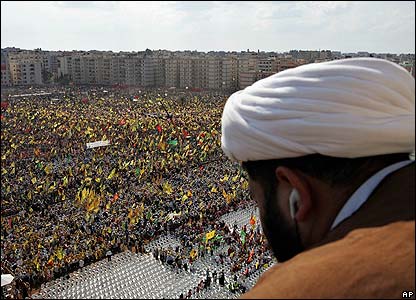
Lebanese Rally for Hezbollah

Just a quick note. In the aftermath of Isreal's assault on Lebanon here's a snapshot of what Lebanese support for Hezbollah looks like:


That's Hezbollah leader, Hassan Nasrallah, in the foreground speaking to the throngs attending a pro-Hezbollah rally last week. It seems the local backlash against Hezbollah we were promised is slow in coming. In fact, one could argue that the exact opposite has transpired. Imagine that.

Read more...