
Katrina Capitalism
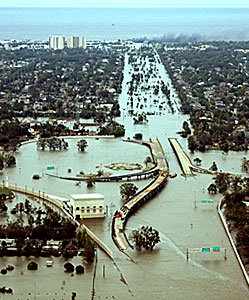 This Katrina anniversary edition would be remiss without the inclusion of Naomi Klein's work on the big-business end of the story. The Bush administration's response to the human dimension of the disaster may have been sorely lacking but it's big-business relief program was swift and sure. We all know how quickly the president suspended prevailing wage requirements in the disaster zone, ensuring that the reconstruction jobs created went, not to local workers displaced from their homes and jobs, but to illegal and migrant workers imported from far and wide to be abused in this deregulated-by-fiat workplace.
That's only one example of how, while citizens drowned in the rising filth that flooded the 9th ward, the big business bailout went off instantly without a hitch. But there so much more. It's all part of the third-worldization of the American workforce disguised as the "free market".
This is all made politically possible by the self-supporting delusion that our anti-government, privatization-crazed leaders have constructed in defense of their policies. Now that they have control of the government, anytime the government does something well (or at least has an excuse to say it did) they claim it as a victory for thier privatization policies and proof that we need even more of them. If the government fails (and fails badly, as with Katrina) they claim it as proof that government solutions are not the answer, therefore it is a victory for their privatization policies and proof that we need even more of them. It is this self-perpetuating loop of lunacy that led us to the disaster we all witnessed on this day last year.
Pay To Be Saved: The Future of Disaster Response
by Naomi Klein
The Red Cross has just announced a new disaster-response partnership with Wal-Mart. When the next hurricane hits, it will be a co-production of Big Aid and Big Box.
This, apparently, is the lesson learned from the government's calamitous response to Hurricane Katrina: Businesses do disaster better.
"It's all going to be private enterprise before it's over," Billy Wagner, emergency management chief for the Florida Keys, currently under hurricane watch for Tropical Storm Ernesto, said in April. "They've got the expertise. They've got the resources."
But before this new consensus goes any further, perhaps it's time to take a look at where the privatization of disaster began, and where it will inevitably lead.
The first step was the government's abdication of its core responsibility to protect the population from disasters. Under the Bush administration, whole sectors of the government, most notably the Department of Homeland Security, have been turned into glorified temp agencies, with essential functions contracted out to private companies. The theory is that entrepreneurs, driven by the profit motive, are always more efficient (please suspend hysterical laughter).
[Snip]
But here's the catch: The U.S. government is going broke, in no small part thanks to this kind of loony spending. The national debt is $8-trillion; the federal budget deficit is at least $260-billion. That means that sooner rather than later, the contracts are going to dry up. And no one knows this better than the companies themselves. Ralph Sheridan, chief executive of Good Harbor Partners, one of hundreds of new counter-terrorism companies, explains that "expenditures by governments are episodic and come in bubbles." Insiders call it the "homeland security bubble."
When it bursts, firms such as Bechtel, Fluor and Blackwater will lose their primary revenue stream. They will still have all their high-tech gear giving them the ability to respond to disasters -- while the government will have let that precious skill whither away -- but now they will rent back the tax-funded infrastructure at whatever price they choose.
Here's a snapshot of what could be in store in the not-too-distant future: helicopter rides off of rooftops in flooded cities ($5,000 a pop, $7,000 for families, pets included), bottled water and "meals ready to eat" ($50 per person, steep, but that's supply and demand) and a cot in a shelter with a portable shower (show us your biometric ID -- developed on a lucrative Homeland Security contract -- and we'll track you down later with the bill. Don't worry, we have ways: spying has been outsourced too)...
This article is actually a long-awated follow-up to Klein's excellent piece, written last year before Katrina hit but after the tsunami in Indonesia, "The Rise of Disaster Capitalism". Prescient it was, a highly recommended read. I ought to add to my "Web Gems" list.
Addendum, 8/30/2006: See also: "Report: Rampant 'Disaster Profiteering' Abuses Needlessly Slowing Rebuilding of New Orleans, Gulf Coast After Katrina"
While "disaster profiteers" -- including Halliburton's Kellogg, Brown & Root (KBR) and Bechtel Group Inc. -- double dip to add to their profits from the also troubled reconstruction of Iraq, local companies and laborers in New Orleans and the rest of the Katrina-devastated Gulf Coast region are systematically getting the short end of the stick, according to a major new report from the nonprofit CorpWatch.
A CorpWatch analysis of FEMA's records shows that "fully 90 percent of the first wave of (the post-Katrina reconstruction) contracts awarded -- including some of the biggest no-bid contracts to date -- went to companies from outside the three worst-affected states. As of July 2006, after months of controversy and Congressional hearings, companies from Louisiana, Mississippi and Alabama had increased their share of the total contracts to a combined 16.6 percent." The CorpWatch analysis shows that more federal reconstruction contracts have gone to Virginia and Indiana -- usually large, politically connected corporations -- than to any of the three Katrina-devastated states.
Titled "Big, Easy Money: Disaster Profiteering on the American Gulf Coast," the CorpWatch report also exposes abusive "contracting charge pyramids" where the companies doing the actual reconstruction work often get only a tiny (and insufficient) fraction of the taxpayer money awarded for projects and widespread non-payment of local companies and laborers, including what has been alleged to be the deliberate and systematic exploitation of immigrant workers, including undocumented individuals.
CorpWatch Director Pratap Chatterjee said: "One year after disaster struck, the slow-motion rebuilding of the Gulf Coast region looks identical to what has happened to date in Afghanistan and Iraq. We see a pattern of profiteering, waste and failure -- due to the same flawed contracting system and even many of the same 'players.' The process of getting Katrina- stricken areas back on their feet is needlessly behind schedule, in part, due to the shunning of local business people in favor of politically connected corporations from elsewhere in the U.S. that have used their clout to win lucrative no-bid contracts with little or no accountability and who have done little or no work while ripping off the taxpayer."
See the full report. Read more...


